
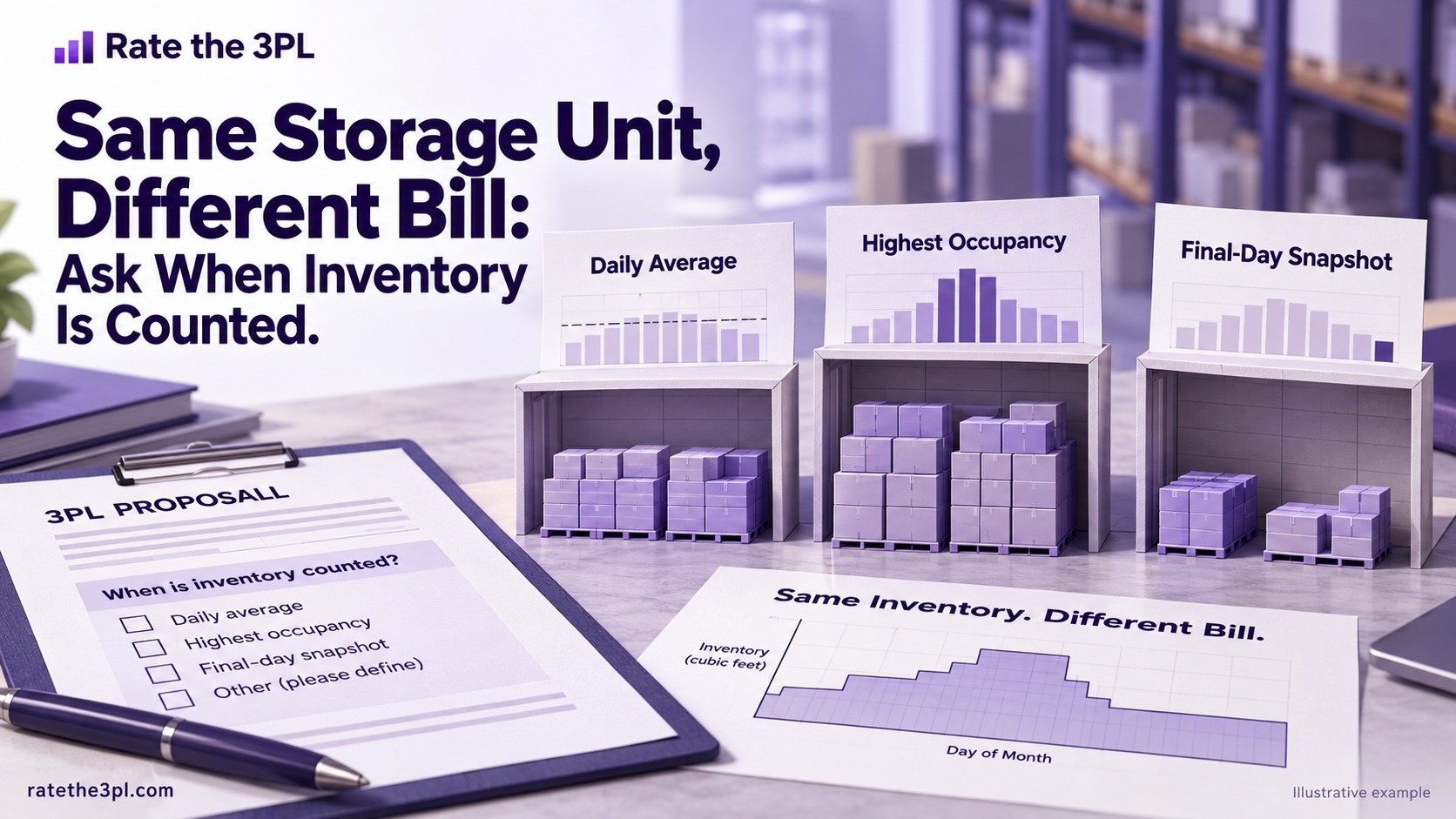
Two quotes can both say “per cubic foot per month” and still produce different bills. One may average daily occupancy; another proposed contract may use a maximum snapshot. Comparing the unit price alone leaves out how many units are billed.
Do not assume either method from a label. Ask the provider to define the time basis and give a worked example. Peak and snapshot methods below are hypothetical contract alternatives, not claims about how a named 3PL bills.
There is a documented daily-average example
Amazon states that FBA monthly storage fees use daily average volume, measured in cubic feet. That is evidence of a specific FBA method, not a universal rule for independent warehouses. Amazon FBA storage fees.
When comparing a 3PL proposal, obtain its own definition. Is the recorded volume based on products, cartons, assigned locations or another agreed basis? Keep those units consistent before examining the timing rule.
Price one month three ways
Original illustrative scenario: a 30-day month holds 600 cubic feet for 10 days, 1,200 for 5 days and 400 for 15 days. Occupancy is assumed constant within each day. Use an invented $1 per cubic foot monthly rate in all three cases; ignore minimums and other fees to isolate the measurement rule.
The daily-volume total is (600 × 10) + (1,200 × 5) + (400 × 15) = 18,000 cubic-foot-days. Divide by 30 to get a 600-cubic-foot daily average.
| Hypothetical measurement rule | Billed cubic feet | Modeled bill |
|---|---|---|
| Daily average | 600 | $600 |
| Highest daily occupancy | 1,200 | $1,200 |
| Final-day snapshot | 400 | $400 |
The same stock history produces three amounts. The cheapest result here does not prove a universally cheapest method. A delivery on the last day would change the snapshot substantially while affecting a daily average for only that day.
A lower rate can still produce a higher total
In this particular scenario, a highest-occupancy rate would need to be $0.50 to equal the $600 average-based bill. That follows from $600 ÷ 1,200. It is a scenario-specific break-even rate, not a negotiation benchmark.
Before using that calculation, confirm whether the provider has reserved space that is charged regardless of occupied volume. A capacity commitment and a usage measurement answer different questions. Do not compare them as if they buy identical services.
Ask what enters the count
Request the timestamp, timezone and treatment of receipt and shipment days. Ask whether quarantined, returned or damaged stock remains billable and how incomplete receipts are represented. Confirm how corrections appear on the invoice and whether the underlying daily history is exportable.
These are contract questions, not assumptions about automatic exclusions. Stock can be unavailable to sell while still physically occupying space.
Bring a real occupancy history to the quote review
Use a representative period that includes replenishment and sell-down. Apply the provider’s written rules to that same history, then add minimums and other explicitly quoted charges. Keep the arithmetic attached to the proposal.
A useful storage comparison ends with a reproducible bill. If the warehouse cannot explain which day, quantity and rule produced its charge, the quote still needs work.
Related reading
Sources
- Amazon documents FBA daily-average volume storage billing — accessed 2026-10-06.