
A quote of $40 per pallet position cannot be ranked against $0.90 per cubic foot by looking at the two numbers. They measure different things. The answer depends on what occupies space, what the provider bills and when the measurement happens.
Start with a common inventory snapshot. Then ask both providers to calculate the bill from it.
Define the object being measured
Keep eaches, inner packs and shipping cases distinct. GS1 US describes these as separate packaging levels; a product's retail unit is not automatically its shipping case. GS1 US packaging levels.
For a storage comparison, document whether dimensions describe the actual case, the product inside it or a storage location. That distinction is your pricing question, not a claim that GS1 sets warehouse billing rules.
Put two fictional quotes through one example
Assume 120 identical cartons, each measuring 18 × 12 × 10 inches externally. Each carton occupies 2,160 cubic inches, or 1.25 cubic feet because a cubic foot contains 1,728 cubic inches. Total carton volume is 150 cubic feet.
Now compare invented monthly pricing assumptions, excluding every other fee:
| Model | Explicit assumption | Monthly calculation |
|---|---|---|
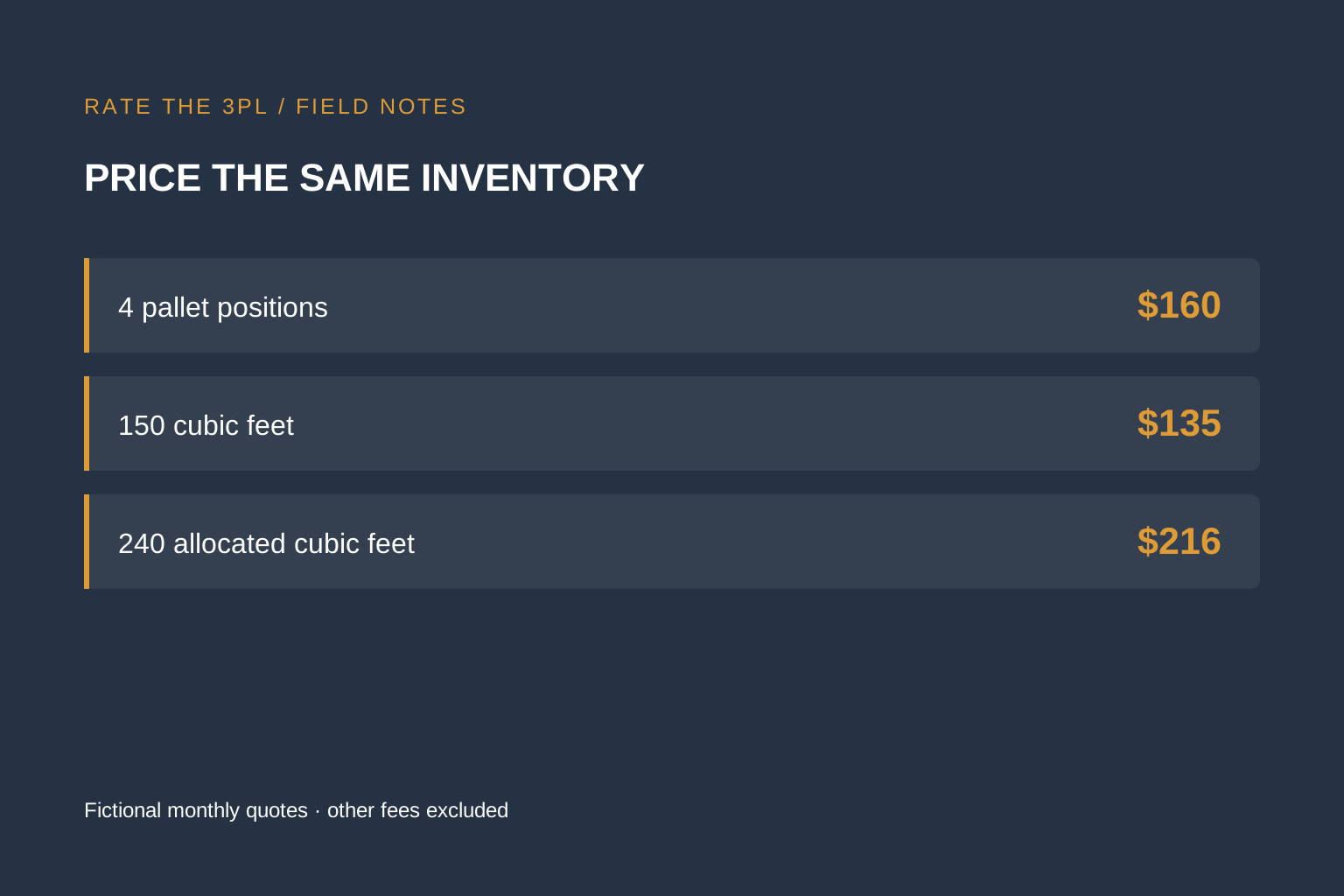
| Pallet positions | Four billable positions at $40 each | $160 |
| Actual carton cube | 150 billable cubic feet at $0.90 | $135 |
The cube model is $25 lower under these assumptions. We have not established that these cartons physically fit in four permitted pallet positions; that is an input requiring a provider layout and stacking check, not a result of the volume calculation.
If the cube quote instead charges 240 cubic feet of allocated space, its bill is $216. It is then $56 higher than the assumed pallet bill. The rate did not change. The definition of billable space did.
Get the measurement rule in writing
Ask whether the charge uses occupied product cube, an allocated bin or rack location, or another basis. Ask how height limits, non-stackable stock, SKU separation and partial locations affect the result. Do not assume unused space disappears from the bill.
For this example, the cube break-even is $160 ÷ $0.90 = 177.78 billable cubic feet. That threshold is useful only while the pallet model stays at four positions and both quotes cover the same period and work.
Compare the calendar too
A month-end snapshot and a daily average can produce different charges for the same business. To illustrate, imagine ten days at six positions and twenty days at three. Across that invented 30-day month, average occupancy is four positions, while maximum occupancy is six and ending occupancy is three.
At the same fictional $40 rate, applying those three different bases gives $160, $240 or $120. These are hypothetical billing formulas, not statements about what a provider normally charges. The contract needs to identify the actual basis.
Score the explanation as well as the estimate
Request a sample storage report with quantities, measurement units, period and exclusions. Then ask for a worked bill and reconcile it yourself. A quote that cannot be reproduced is difficult to manage even if the headline rate looks attractive.
Add receiving, handling, transportation and other charges separately with the whole-order pricing guide. Use the quote stress test to model replenishment weeks as well as quiet inventory days.
Sources
- Source 1 — accessed September 25, 2026.