
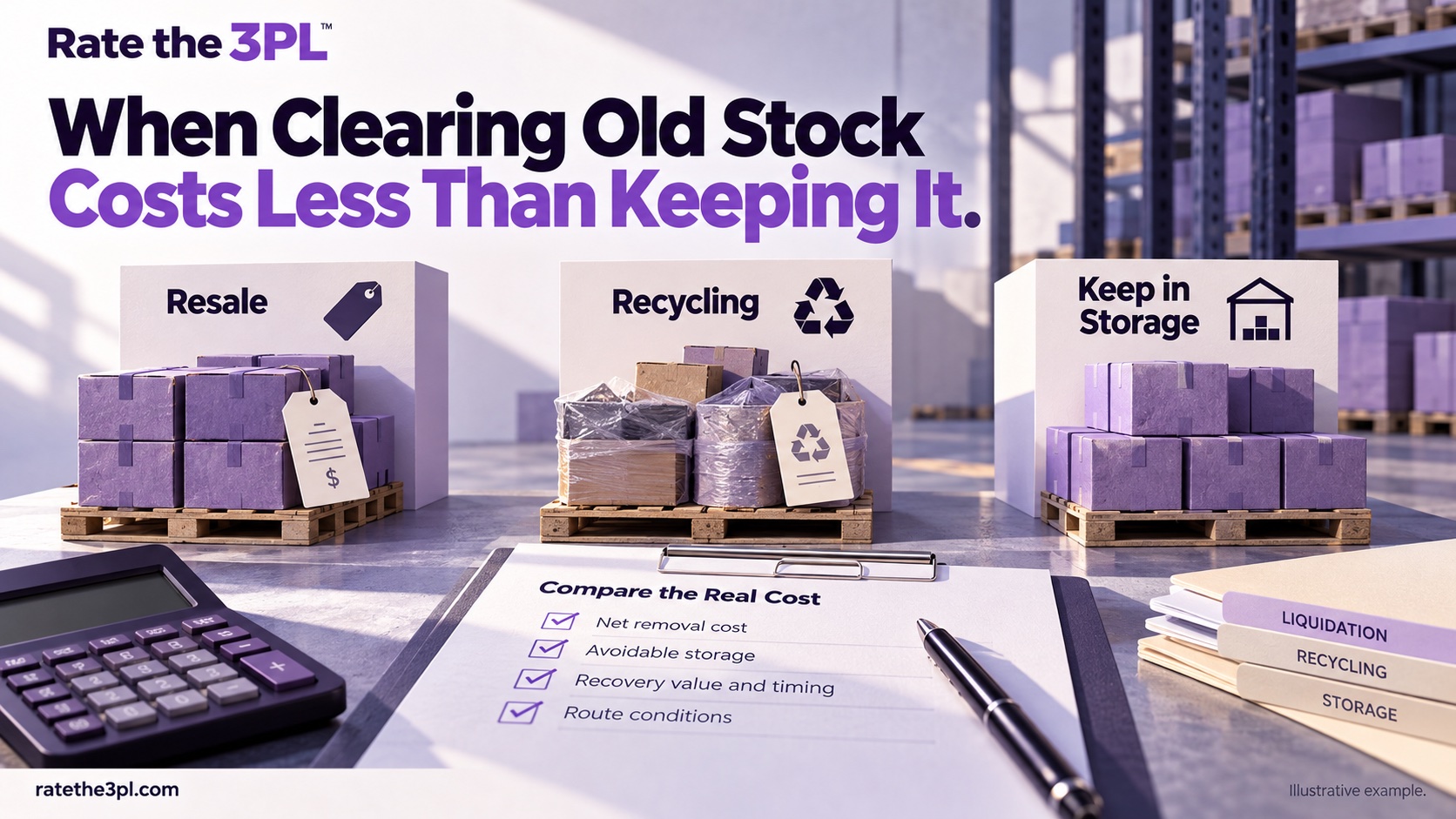
Old stock can look inexpensive while its monthly bill is spread across the rest of the inventory. Before approving clearance, isolate the cost that would actually disappear when those goods leave. Allocated warehouse overhead is not necessarily an avoidable charge.
The next question is what removal means. Resale, donation, reuse, recycling and disposal have different operational conditions. EPA’s non-hazardous materials hierarchy favors prevention and reuse ahead of downstream waste management. That environmental framework does not determine whether your products are safe, eligible or economical for a particular route.
Compare two approved removal routes with holding
The following original scenario uses invented amounts to demonstrate the calculation. It is not a market quote, forecast or recommendation to dispose of a specific product. Assume 20 pallets of eligible stock, $18 per pallet-month of genuinely avoidable storage, no contractual minimum preventing savings, and immediate physical removal.
| Option | Handling and transport | Recovery proceeds | Net removal cost |
|---|---|---|---|
| Approved liquidation | $900 | $500 | $400 |
| Approved recycling | $450 | $0 | $450 |
| Keep for three months | $1,080 storage | Unknown | Future removal still unresolved |
Avoidable monthly storage is 20 × $18 = $360. Liquidation’s $400 net removal cost equals about 1.11 months of that storage; recycling’s $450 equals 1.25 months. These ratios compare removal outlay with avoided storage only. They do not include lost future sales contribution, taxes or a later disposition cost.
Test the weak assumption first
Liquidation appears $50 cheaper here, but its $500 proceeds are an assumption. If proceeds are only $200, net cost becomes $700 and the storage-equivalent period rises to about 1.94 months. Recycling then has the lower direct net removal cost, assuming both routes remain acceptable.
A buyer should therefore ask for the basis of recovery proceeds, payment timing and any deductions before selecting a route. Do not treat an estimated resale value as cash already received. Likewise, do not book a donation tax benefit into this comparison without separate qualified advice.
Savings start when the bill changes
Confirm the date stock will physically leave and the billing rule that removes the charge. If one further full month is billed before removal, this example adds $360 to either route. Request the pickup booking and warehouse confirmation; an authorization email does not empty a pallet position.
Check minimum storage charges, rounding, retrieval labor, sorting, packaging, transport and destination acceptance. If the account stays at a minimum bill after clearance, the immediate storage saving could be zero. That would invalidate the simple payback comparison.
Approve the goods as well as the price
Name the SKUs, quantities, permitted destination and evidence required after removal. Product restrictions, recalls, safety and brand controls may rule out an otherwise attractive route. Keep this gate separate from the arithmetic.
The useful scorecard has four lines: eligibility confirmed, net outlay supported, avoidable storage verified, and completion evidenced. It helps a brand distinguish a cheap-looking quote from a clearance decision that actually changes its costs.
Related reading
Sources
- EPA non-hazardous waste hierarchy — accessed 2026-10-18.