
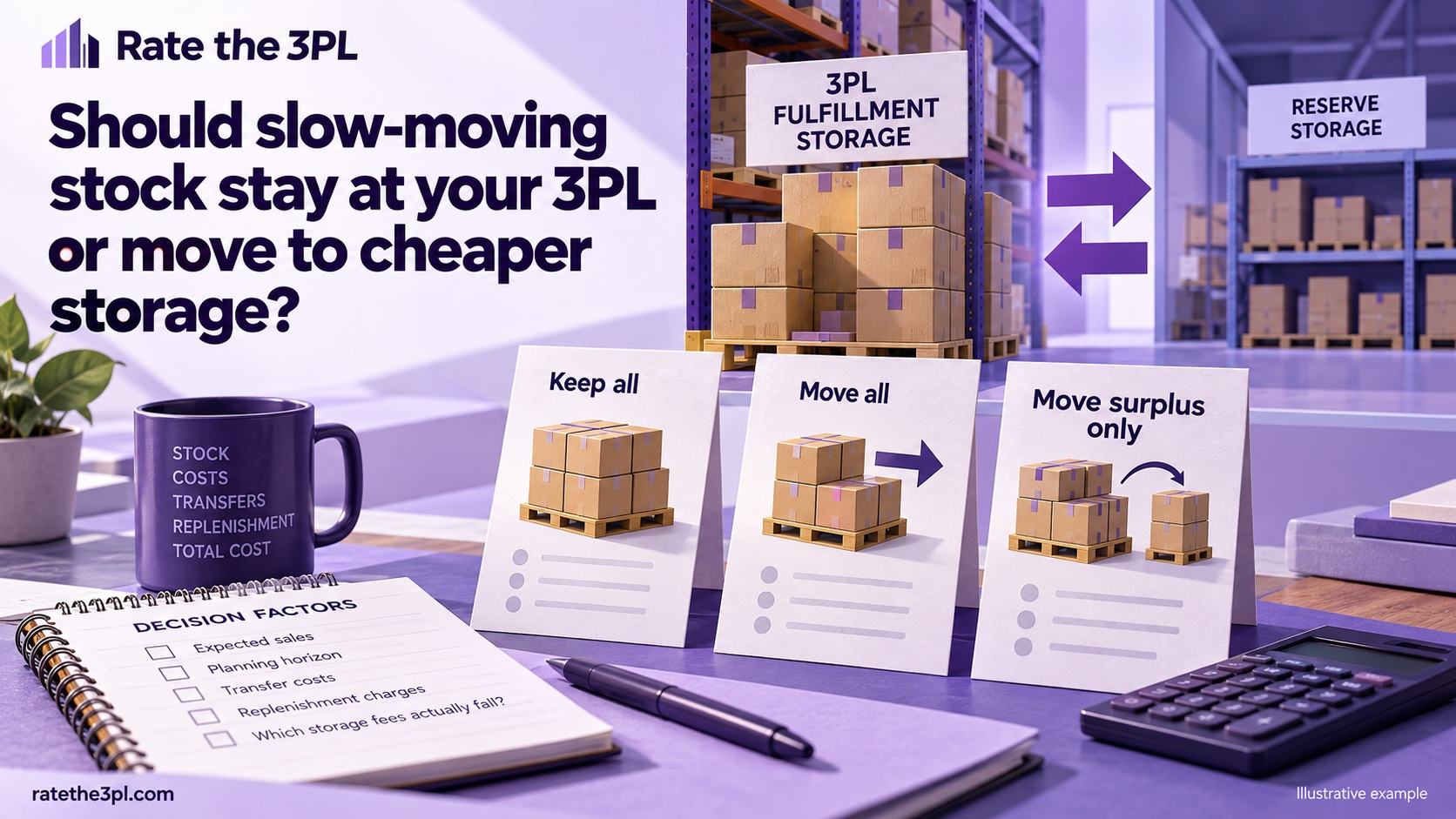
A low storage rate is tempting when an aging product keeps appearing on the fulfillment invoice. Moving the stock can help. It can also create a second storage bill and a repeated transfer job that costs more than staying put.
The decision should be made by SKU and planning horizon. A product that will sell through in three weeks presents a different problem from a seasonal item you intend to keep until next year. Neither is solved by comparing two storage rates in isolation.
Establish what is actually likely to move
Start with available units, recent sales, committed orders and the merchandising plan. Shopify's inventory report documentation defines days of inventory remaining using inventory and average sales; a variant with no sales can show N/A. That field does not mean zero stock, and a historical average is not evidence that the next promotion will perform the same way.
Ask the 3PL which charges would disappear if you remove inventory. A half-empty pallet position may remain billable. A monthly minimum may absorb the reduction. A quote using unit-based storage does not transfer automatically to an account billed by pallet, bin or minimum footprint.
Compare three options on the same horizon
Our original illustration starts with 800 units and assumes sales of 100 units per month for three months. Storage is charged on beginning-of-month units. All rates below are invented solely to explain the comparison.
Assume active fulfillment storage costs $0.25 per unit per month and reserve storage costs $0.08. Standard outbound customer fulfillment is identical across options and excluded. There are no minimums, taxes, damage, financing costs or aged-stock surcharges in this simplified model.
| Three-month option | Calculation | Total |
|---|---|---|
| Keep all 800 units at the fulfillment warehouse | (800 + 700 + 600) × $0.25 | $525 |
| Move all units to reserve and replenish sold quantities | $300 initial transfer + (800 + 700 + 600) × $0.08 + $150 replenishment allowance | $618 |
| Keep 300 active units; move 500 surplus units | (300 + 200 + 100) × $0.25 + $220 transfer + 500 × $0.08 × 3 | $490 |
For the all-reserve case, replenishment happens just in time for dispatch without an additional active-storage charge; the $150 allowance covers all three months of replenishment handling and transport. Those are assumptions to challenge in a real quote. The split case needs no replenishment during this horizon because its 300 active units cover the assumed sales.
Moving everything costs $93 more despite the much lower storage rate. Moving only the surplus saves $35. That small advantage is fragile: another $36 of unmodeled cost would reverse it. The arithmetic is useful precisely because it makes the weak margin of advantage visible.
Do not erase the bill after month three
The split option still leaves 500 units in reserve. Returning them to active fulfillment, disposing of them or moving them elsewhere will create later costs that the three-month table does not include. Extend the horizon if the stock decision will remain in place longer.
Likewise, if actual demand exceeds the 300 active units, the split plan needs earlier replenishment. Price both a normal transfer and the recovery process when the active location runs out. Do not call the plan cheap while assuming urgent transfers will somehow be free.
Request charges in a form you can calculate
Ask both warehouses for the charging unit, minimums, billing snapshot, transfer preparation, loading, freight, destination receiving, replenishment handling and exit charges. Check whether mixed pallets or partial cases change the work.
The evaluation scorecard should show total cost, active stock coverage, replenishment lead time and the unresolved charges. Mark unknown fees as unknown rather than entering zero. Decide whether the modest expected saving justifies another inventory location and another handoff.
Sometimes the best answer is to keep the stock while changing the selling plan. Sometimes moving the surplus protects valuable active space. Make that choice from a complete incremental comparison, with the future exit still visible.
Related reading
Sources
- Shopify inventory-report definitions and the no-sales limitation — accessed 2026-10-03.