
The posted percentage is not the full invoice calculation OSM Worldwide's official U.S. fuel policy lists 13.50% for October 5–November 1, 2026 and 15.75% for November 2–December 6, 2026. The page describes a monthly indexed fuel surcharge and warns that terms can change. These are posted fuel rates, not warehouse handling fees or a newly inferred peak surcharge. The page does not establish the specific charge base or pass-through arrangement of a reader's 3PL account. OSM fuel policy, checked October 29.
Before applying either percentage, obtain the account's eligible services, charge categories, billing period and applicable tariff or agreement. A total shipping invoice can contain items that should not simply be multiplied by the fuel percentage.
Hold the eligible base constant first We calculated three hypothetical cases. The dollar bases below are invented amounts assumed to be entirely fuel-eligible under a hypothetical agreement. They are not OSM prices, a definition of eligible charges, or quotes from a fulfillment provider.
| Illustrative eligible base | Fuel at 13.50% | Fuel at 15.75% | Increase |
|---|---|---|---|
| $10,000 | $1,350 | $1,575 | $225 |
| $20,000 | $2,700 | $3,150 | $450 |
| $30,000 | $4,050 | $4,725 | $675 |
At a constant base, multiply by 0.0225 to isolate the rate-change effect. The increase is 2.25 percentage points. It is about 16.67% of the old fuel amount, but it is not a 16.67% increase in the entire transportation bill.
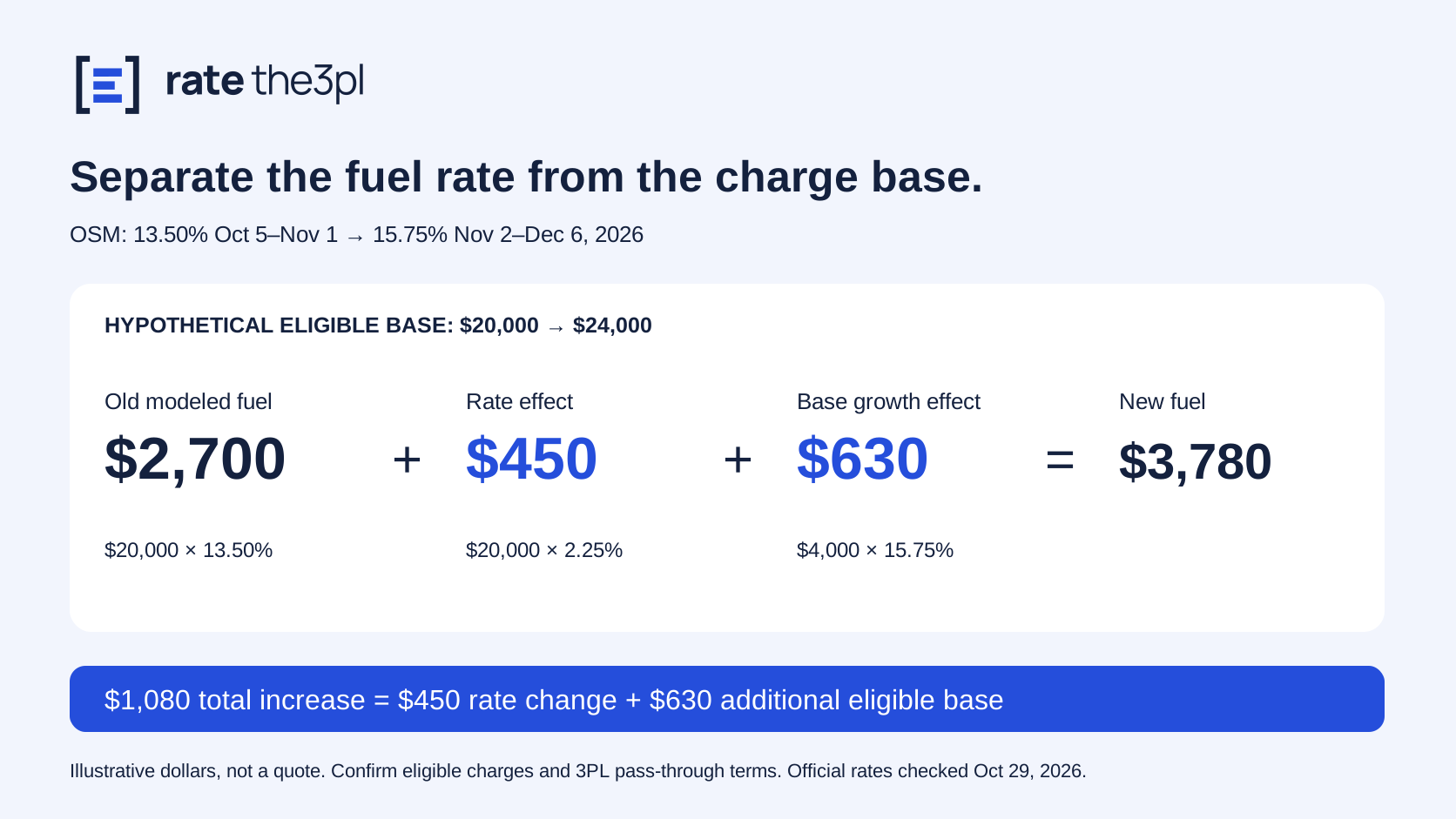
Then allow the base to change Suppose a brand's hypothetical eligible base grows from $20,000 to $24,000 between comparable periods. At the new rate, modeled fuel is $3,780 instead of the old $2,700: a $1,080 increase.
One useful decomposition is $450 from changing the rate on the original $20,000 base, plus $630 from the extra $4,000 base at 15.75%. Together they equal $1,080. The second part could reflect shipment volume, shipment mix or changes in eligible transportation prices. It cannot be attributed to more orders without further evidence.
This is a scenario calculation, not a forecast. It assumes every dollar in each stated base is eligible, with no contractual cap, special discount or other adjustment. It adds no fuel-on-fuel calculation and makes no assumption that demand fees are fuel-eligible.
Ask for a bridge between carrier and 3PL billing Request a worked shipment example showing the underlying transportation amount, eligible additions, fuel calculation and the 3PL's billing treatment. If fuel is bundled into a shipping price, ask how that price changes and how the change is communicated. If a markup applies, ask which amount it uses. Do not presume either arrangement.
Reconcile a like-for-like shipment sample across the effective-date boundary. Preserve shipment date, service, weight, destination and the account terms used. Keep warehouse receiving, storage and pick fees outside this transportation comparison unless the agreement explicitly defines a different combined product.
Use the result in the quote decision A provider offering a lower headline fuel percentage may still have a different transportation base or bundled charge. Compare the final cost for the same order mix and retain the calculation trail. Conversely, a higher fuel line does not by itself prove that a 3PL increased its own margin.
The official page's original announcement date was not established during this review. Recheck the posted table and account applicability before using the scenario in a live budget. The useful selection evidence is a reproducible calculation under your terms, not a percentage copied into a spreadsheet without its base.
Further reading
Sources
- https://www.osmworldwide.com/fuel-surcharge-policy/ — accessed 2026-10-29.