
A fuel-rate announcement is a budgeting input, not a complete forecast. If the percentage changes but the amount it applies to is still unclear, a precise-looking spreadsheet can give you the wrong answer.
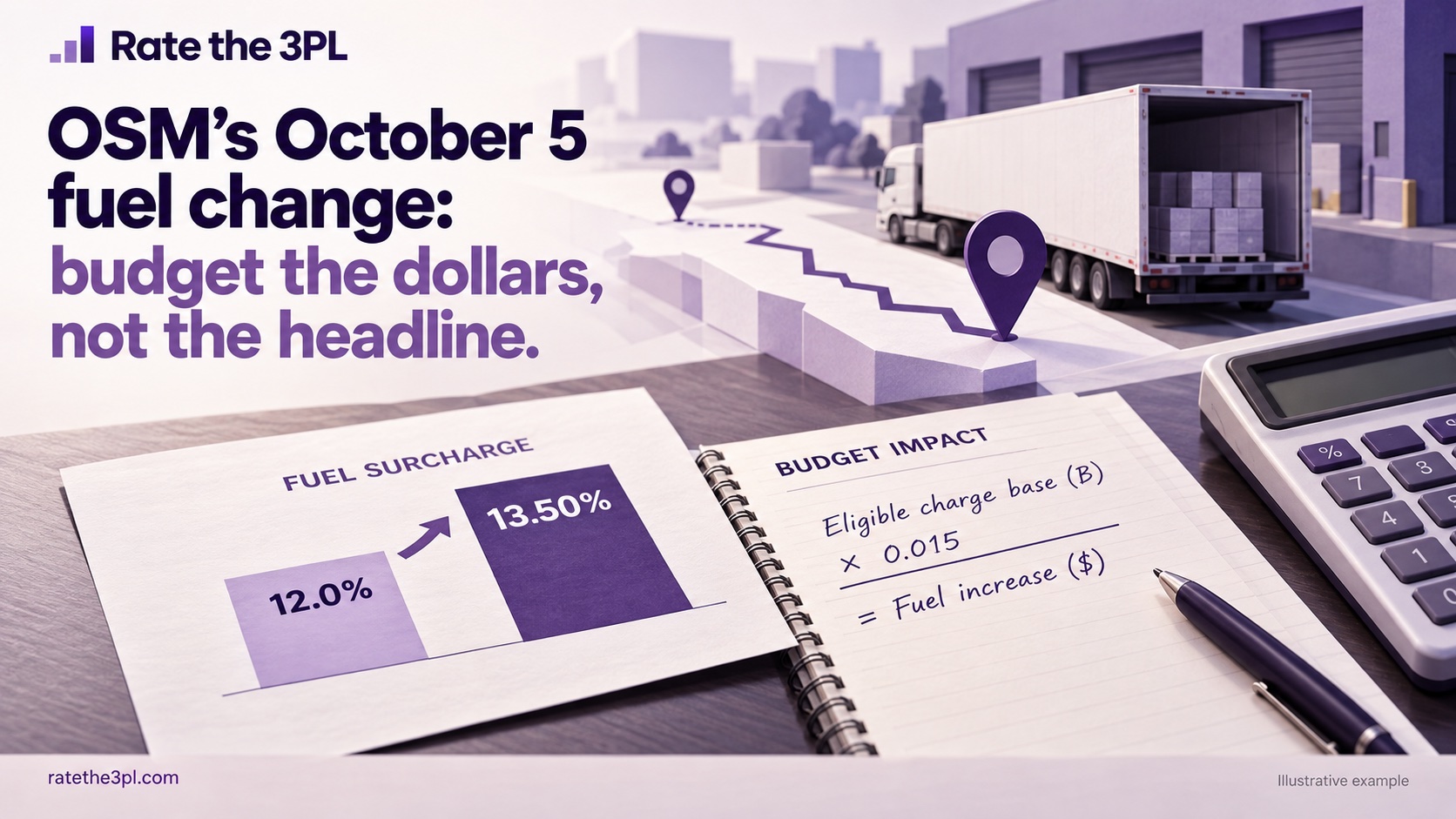
OSM Worldwide's public fuel policy lists 12.0% for September 7–October 4, 2026 and 13.50% for October 5–November 1, 2026. It is a published monthly fuel schedule for OSM's U.S. shipping operation, not a demand fee or a warehouse rate increase. The page gives effective periods but no separate announcement date, and says the schedule is subject to change. OSM fuel policy
Keep three numbers separate
The difference is 1.5 percentage points. Relative to the old 12.0% surcharge, the surcharge rate is 12.5% higher: 1.5 divided by 12. That does not mean transportation spending or the full 3PL bill rises 12.5%.
The dollar impact depends on the eligible charge base. For budgeting, call that base B. With an unchanged base, the direct increase is B × 0.015. Confirm what belongs in B from the applicable tariff and your agreement; the public schedule alone does not establish every account's charge treatment.
Three illustrative budgets
We calculated three synthetic charge-base scenarios. These are not OSM quotes, observed invoices or claims about market pricing. They assume the published percentage applies without a negotiated cap, exemption or different 3PL billing arrangement.
| Confirmed eligible base for the period | Fuel at 12.0% | Fuel at 13.50% | Difference |
|---|---|---|---|
| $20,000 | $2,400 | $2,700 | $300 |
| $30,000 | $3,600 | $4,050 | $450 |
| $40,000 | $4,800 | $5,400 | $600 |
For the middle case, base plus fuel changes from $33,600 to $34,050. That is approximately 1.34% more for this two-component subtotal. Other transportation charges and warehouse services are excluded. The distinction matters: the same announcement can sound much larger when expressed as the relative change in the surcharge alone.
Allow volume to change too
Suppose the previous period's eligible base was $30,000 but the next period's is $40,000. Fuel changes from $3,600 to $5,400, an $1,800 increase. Only $600 is the rate effect measured on the new base. The remaining $1,200 reflects the extra $10,000 of base at the old rate.
This decomposition is an original budgeting example. It prevents a promotion-driven increase in shipments from being attributed entirely to the carrier's new percentage. It still does not explain why the base changed; investigate shipment count, service mix and underlying rates separately.
Ask your 3PL for a usable forecast
Request the applicable service, eligible charge categories, effective-date trigger and whether your agreement passes fuel through directly, incorporates it into a bundled rate or uses another mechanism. Ask how credits and adjustments are handled. Keep pick-and-pack, storage and unrelated fees out of the fuel calculation unless the actual agreement expressly establishes otherwise.
Do not add a separate fuel line to a quote that already includes it. Do not apply fuel to a demand charge without confirming the applicable rule. And do not rank carriers on fuel percentages alone: different bases and underlying prices can reverse that comparison.
The useful output is a range tied to documented assumptions. Recheck OSM's schedule before publication or a live budget update, replace these hypothetical bases with the applicable charges and keep the 3PL's billing terms alongside the calculation.
Related reading
Sources
- Published OSM fuel schedule and change policy — accessed 2026-10-04.