
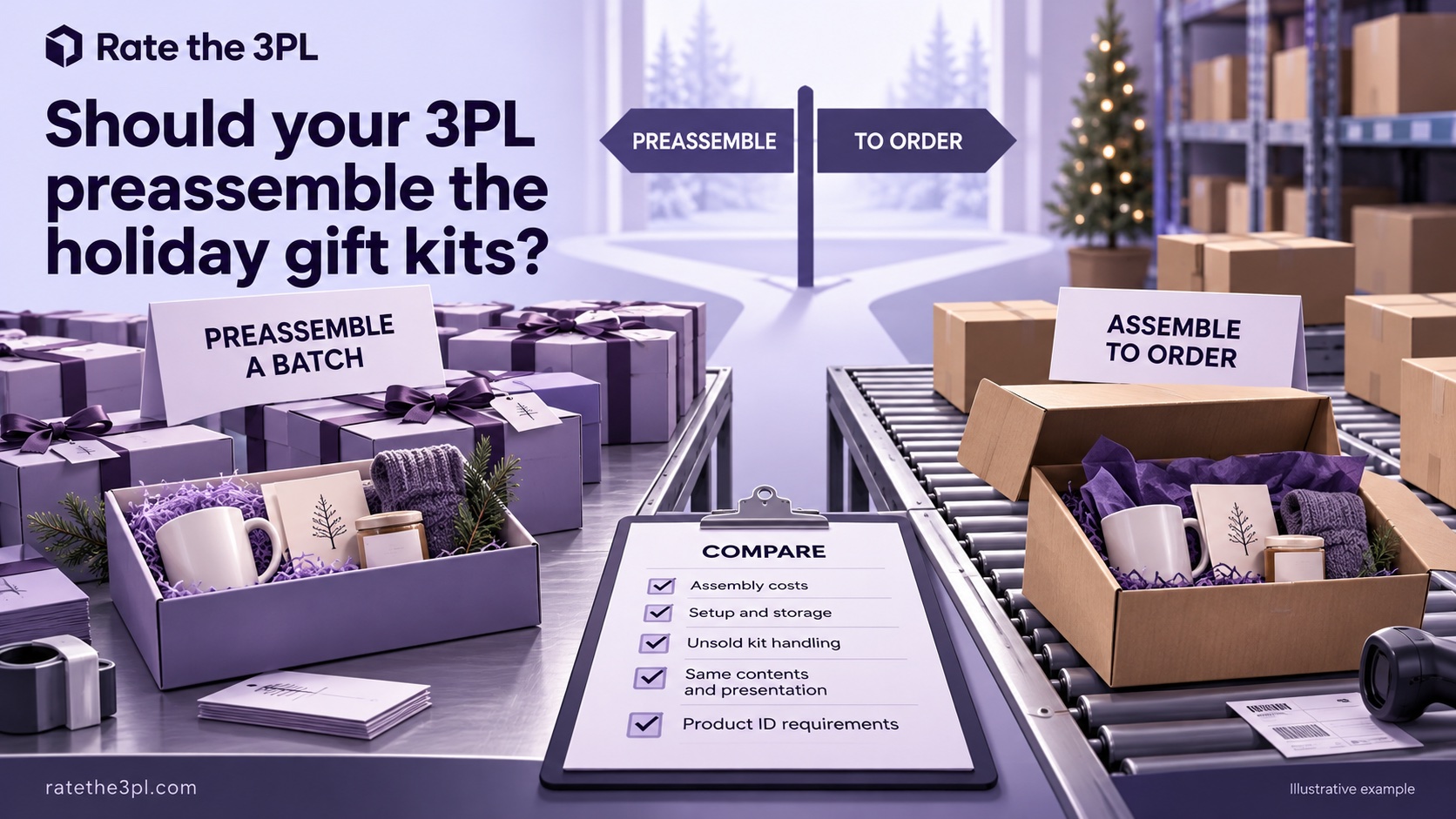
Preassembling a holiday gift kit can make the shipping bench simpler. The financial result depends on what happens to the kits that do not sell.
Ask your 3PL for two complete prices: assemble a batch before launch, or assemble only when an order arrives. Compare them at more than one sales outcome. A low assembly rate applied to every planned kit can cost more than a higher rate applied only to sold units.
Define the kit before requesting the price
Give both options the same contents, presentation standard and expected order mix. Specify whether the quote includes setup, storage, component picking, final packing and taking unsold kits apart. Confirm whether dismantled components can return to normal stock and what inspection or relabeling that requires.
Identity also matters. Under the GS1 predefined-assortment rule, changing a constituent item in a fixed physical assortment requires a new GTIN. Do not treat a last-minute substitution as merely a packing instruction; review the applicable product identification and trading-partner requirements.
The comparison below concerns assembly-related costs only. It excludes product cost, outbound shipping and the common final pack-and-dispatch work. Replace those equal-cost assumptions if the two methods produce different parcels or service charges.
Compare two sales outcomes
Our illustrative batch contains 1,000 kits. Assume preassembly costs $0.80 per kit, with $150 setup and $100 additional storage. Every unsold kit is dismantled at the end of the campaign for $0.50. Assembly to order costs $1.60 per sold kit, with no separate setup or storage increment in this example. None of these numbers is a provider quote.
| Sales outcome | Preassembled batch | Assembly to order | Lower modeled cost |
|---|---|---|---|
| All 1,000 sell | $1,050 | $1,600 | Preassembly by $550 |
| Only 600 sell | $1,250 | $960 | To order by $290 |
For 600 sales, the preassembled total is $800 assembly, $150 setup, $100 storage and $200 to dismantle 400 unsold kits. The to-order total is simply 600 multiplied by $1.60.
The model assumes unused components remain recoverable. Damaged packaging, obsolete inserts or products that cannot be returned to sale would make preassembly more expensive than this calculation shows.
Find the sell-through threshold
Let S be the number of kits sold from the 1,000-unit batch. Preassembly costs $1,550 minus $0.50 times S; assembling to order costs $1.60 times S. The totals meet at about 738.1 kits. At whole-unit sales, preassembly first becomes cheaper at 739 sold kits, or 73.9% sell-through.
That threshold belongs only to these assumptions. A different storage period, setup fee or dismantling policy changes it. If leftover kits remain saleable into the next season, model that outcome separately instead of charging automatic dismantling.
Put capacity beside the cost result
Cost is not the only reason to build ahead. A brand may prefer preassembly to reduce work during a concentrated launch. Ask the warehouse to demonstrate the actual labor and space plan for both options rather than assuming the lower-cost option can handle the deadline.
A smaller initial batch followed by a replenishment batch is another option to quote. It may reduce unsold-kit exposure while introducing additional setup work. Request the price before treating that compromise as free flexibility.
The buying decision is a combination of demand confidence, recoverability and operating capacity. Choose the batch size with those conditions written down, and review it when the sales forecast or kit contents change.
Related reading
Sources
Research checked October 2, 2026. Recheck source-specific requirements before publication.