
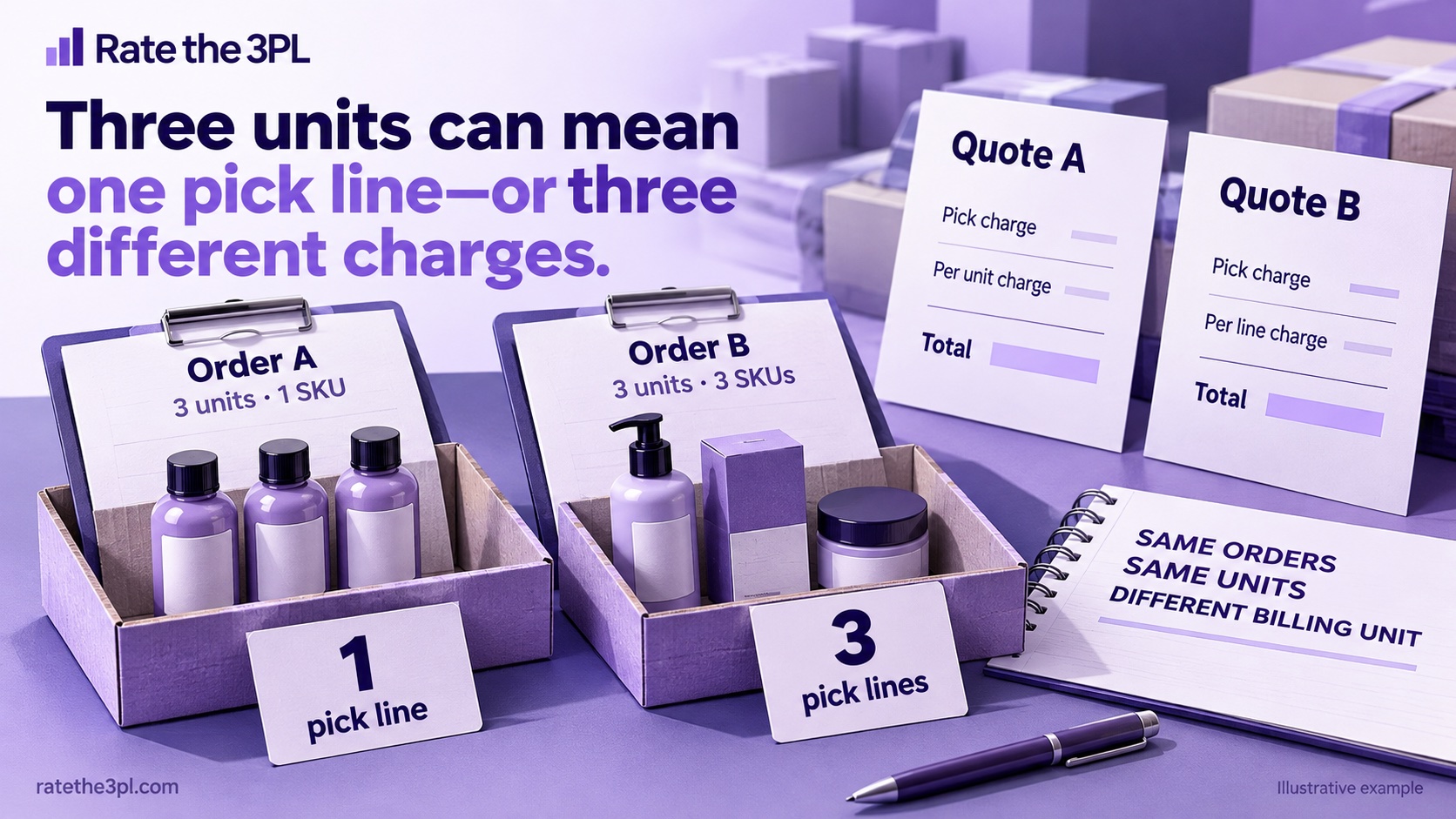
“Three items per order” sounds like enough information for a picking quote. It is not enough when providers use different billing units.
Three bottles of the same product can be one order line with quantity three. Three different products can be three lines. Before comparing the prices, settle what each provider means by a pick.
Build a basket file with all three counts
Shopify's order export documentation lists line-item quantity and SKU fields. It also explains that additional lines of a multi-item order appear on separate CSV rows, with some order fields left blank. Do not treat every exported row as a separate order. Shopify order export structure.
For your analysis, reconstruct order groups, preserve quantities and identify which lines actually require shipping. Ask the 3PL how kits, multipacks and cases are billed; their billing definition may differ from the storefront's product representation.
Compare two explicitly fictional tariffs
For this desk calculation, Quote A charges $2 per order plus $0.40 for each physical unit after the first. Quote B charges $1.50 per order plus $0.75 for every line, including the first. These invented rates illustrate billing mechanics; they are not market averages or named-provider offers.
We calculated two batches of 100 orders. Both contain 300 units.
| Basket pattern | Lines in batch | Quote A | Quote B |
|---|---|---|---|
| Three units of one SKU per order | 100 | $280 | $225 |
| One unit of each of three SKUs per order | 300 | $280 | $375 |
Quote A is $200 plus 200 additional units at $0.40 in both cases. Quote B is $150 plus either 100 or 300 lines at $0.75.
B is $55 cheaper for the repeated-SKU batch. A is $95 cheaper for the mixed-SKU batch. The preferred quote flips even though total orders, total units and average units per order do not change.
Translate the example into your quote review
Send both providers the same anonymized basket file. Ask each to return the applied billing unit and extended charge for each basket pattern. Include at least a single-unit order, repeated units of one SKU, several different SKUs, and a kit sold as one storefront product.
Request a written answer on whether the first pick is included and whether a line means a SKU, a location visit, a case, or something else in that contract. Do not resolve unclear wording by assuming the interpretation that produces the cheaper bill.
Keep the comparison's boundary visible
This example covers picking only. It excludes packaging, storage, receiving, minimums, technology, returns and transportation. Carrier fuel and holiday charges belong in a separate shipping calculation using the applicable service and account rules. They should not be silently folded into a pick-fee comparison.
Once the picking definitions match, combine the result with the rest of the quote. A provider that loses this narrow calculation may still offer the better total arrangement. The useful result is an explainable bill, not a winner selected from the smallest number on a rate card.
Related reading
Sources
Accessed September 29, 2026. Recheck platform and carrier terms before publication.