
A rate table needs a calculation rule
“$3 per order up to 1,000; $2.50 above 1,000” is not a complete pricing instruction. Does the lower rate apply to all qualifying orders in the month, or only the orders after the first thousand?
Both interpretations can be modeled. The important buying step is to have the provider state which one the contract uses, when the volume is measured and which orders count. A small worked invoice is more useful than assuming the word tier has a universal meaning.
Compare two explicit hypothetical rules
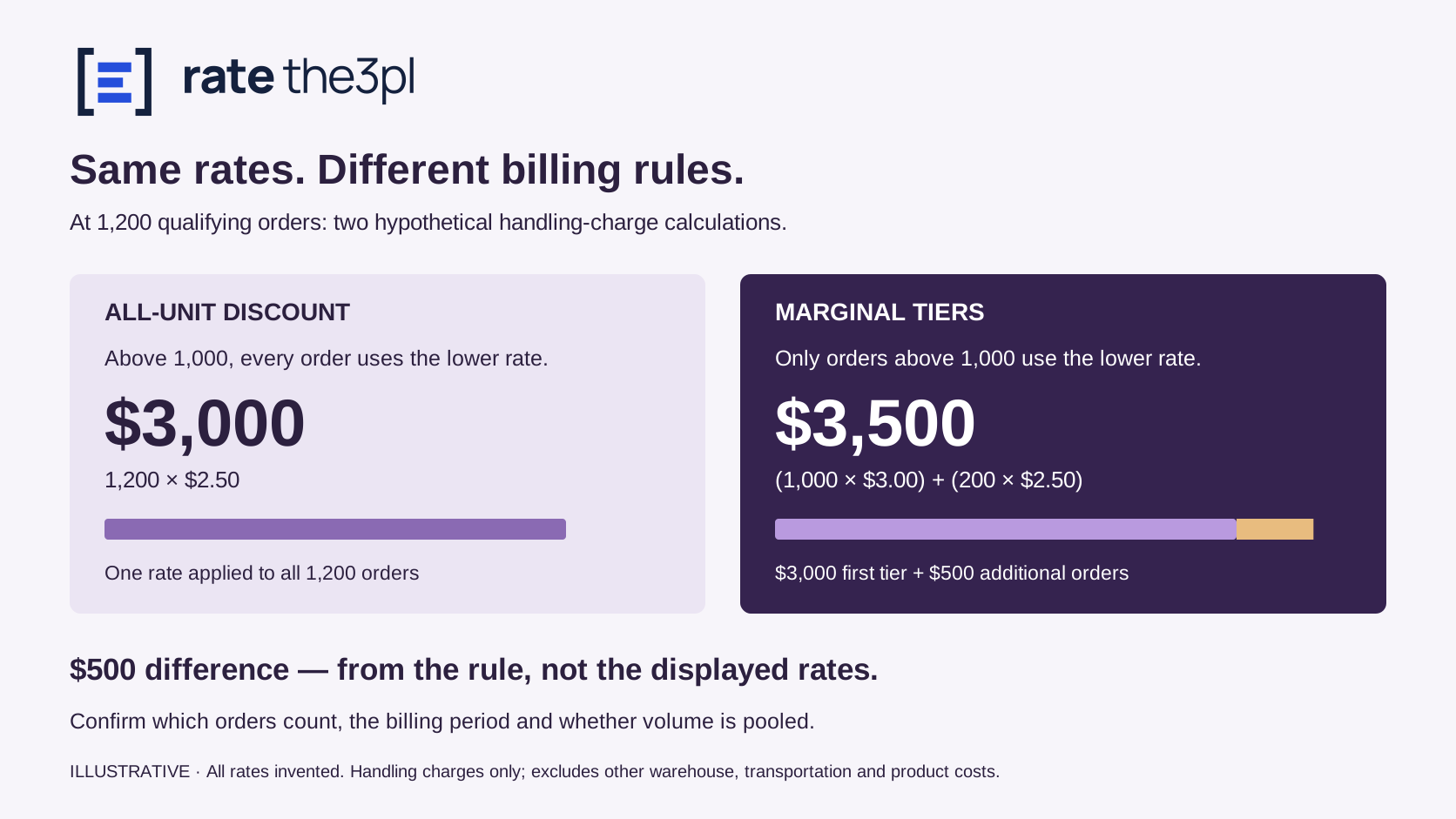
All numbers below are invented handling charges, excluding other fees. Rule A is an all-unit monthly discount: at 1,001 or more qualifying orders, every order costs $2.50. At 1,000 or fewer, every order costs $3. Rule B is marginal: the first 1,000 orders always cost $3 each and additional orders cost $2.50 each.
| Qualifying orders | Rule A: all-unit | Rule B: marginal | Difference |
|---|---|---|---|
| 999 | $2,997 | $2,997 | $0 |
| 1,000 | $3,000 | $3,000 | $0 |
| 1,001 | $2,502.50 | $3,002.50 | $500 |
| 1,200 | $3,000 | $3,500 | $500 |
For 1,200 orders, Rule B is $3,000 for the first thousand plus $500 for the remaining 200. Rule A is 1,200 × $2.50. The average handling charge is therefore $2.50 under A and about $2.92 under B. These are not full cost-per-order figures.
Notice the threshold before forecasting savings
Under Rule A, moving from 1,000 to 1,001 orders reduces the total handling bill by $497.50. That discontinuity follows from our deliberately explicit all-unit rule. It is not evidence that real 3PLs offer this structure, and it is a reason to ask for clarification if a quote seems to imply it.
Under Rule B, the same extra order adds $2.50. A spreadsheet that applies the lower rate to the whole month would understate that hypothetical invoice by $500 once the threshold is exceeded.
Do not ship unnecessary orders to chase an apparent threshold. Transportation, product costs and other fees may exceed the handling benefit. Confirm whether any discount is billed immediately, credited later or based on a different period.
Define the count as carefully as the rate
Ask which events qualify: orders accepted, completed, handed to a carrier or invoiced. Ask how cancellations, split shipments, reships, retail orders and manual orders are treated. These are questions for the provider, not assumptions about standard practice.
Then clarify whether several warehouses or stores share one volume pool. A brand with 600 orders at each of two locations might have 1,200 pooled orders or two separate 600-order accounts. The table cannot answer that contractual question.
Retain the provider's worked examples at one order below, exactly at and one order above the threshold. Include the billing period and treatment of any later adjustments.
Put the discount inside the whole quote
The SBA's cost guidance separates fixed, variable and mixed costs. Apply that distinction when adding account fees or other charges around this handling model. A monthly minimum, if present, needs its own formula; it should not be silently treated as an additional fee or assumed to disappear.
We calculated eight hypothetical bills across four volumes. No provider quotes were sampled. The finding is mathematical: identical displayed rates can produce different invoices when the tier rule differs. Choose a provider using the complete, confirmed billing method and required service evidence, not the smallest number in a rate table.
Related reading
Sources
- Primary source 1 — accessed 2026-10-27.