
Put two separate questions on the budget sheet
UPS has announced changes effective November 2, 2026 to its US Ground Domestic/Ground Saver and Domestic Air fuel surcharges. Its official page says weekly indexing continues and the changed tables will be reflected on the website beginning October 29. This is an announced future change, not a statement of the percentage that will apply to your particular November shipment. UPS fuel notice page.
For a brand using a 3PL, the first question is which fuel rule applies to the shipment. The second is which dollars that rule is applied to. A percentage without its charge base cannot produce a defensible cost estimate.
Separate the services and the kinds of fees
The linked UPS notice covers domestic ground and domestic air categories, with separate indexes. It identifies a retail-rate exclusion for UPS Ground packages originating in the contiguous 48 states. It also says fuel applies to transportation and certain other charges. Do not extend the notice to every international shipment or every retail parcel. Effective November 2 notice.
Fuel, demand charges, base transportation rates and warehouse handling fees are different lines in the analysis. Whether a particular additional charge attracts fuel needs its own confirmation. Applying fuel to the whole fulfillment invoice would silently assume that picking, storage and every other fee belong in the carrier calculation.
Measure sensitivity without pretending to know the weekly rate
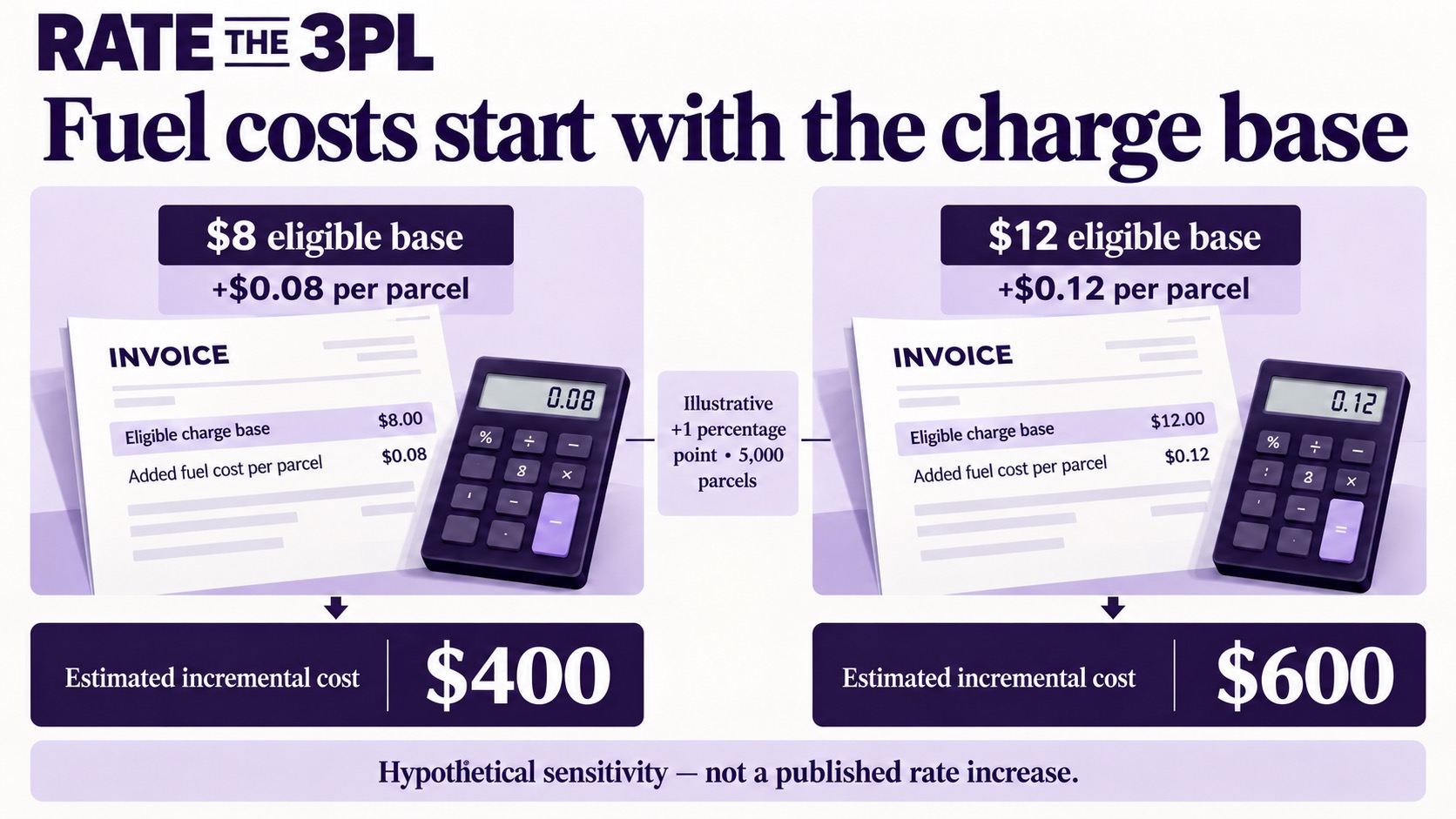
We calculated four hypothetical cases. Each uses 5,000 parcels and a fixed assumed eligible charge base. The percentage-point changes below are sensitivity inputs, not published increases or forecasts for November 2.
| Assumed eligible base per parcel | Hypothetical fuel increase | Increment per parcel | Increment for 5,000 parcels |
|---|---|---|---|
| $8 | 0.25 percentage points | $0.02 | $100 |
| $8 | 1.00 percentage point | $0.08 | $400 |
| $12 | 0.25 percentage points | $0.03 | $150 |
| $12 | 1.00 percentage point | $0.12 | $600 |
The calculation is parcel count × eligible base × decimal change. A 0.25-percentage-point movement is 0.0025 in that formula. Holding the movement constant, the larger base produces 50% more incremental cost in these examples. That is arithmetic under the stated assumptions, not an estimate of any provider's bill.
Ask for one traceable example from the 3PL
Request a sample that identifies service, shipment date, transportation charge, additional fuel-eligible charges, percentage and resulting fuel amount. Ask whether discounts, negotiated terms or the 3PL's own billing arrangement change what reaches your invoice. Do not assume the carrier's published fee passes through unchanged.
Keep the warehouse fee comparison separate. If two providers present different fuel amounts, first establish whether they used the same service, date, eligible base and billing terms. A lower percentage attached to a larger base can be misleading.
Refresh the estimate when the inputs are known
The practical next step is to mark the model as provisional, obtain the applicable weekly rate and confirm the account's charge base before using it as a quote comparison. The sources reviewed on October 23 do not establish an end date for this table change or an account-specific result.
Keep the old assumptions beside the revised ones. That makes it possible to explain whether the budget moved because of the fuel table, the shipment mix or the provider's pass-through arrangement, without counting the same fee twice.
Related reading
Sources
- https://www.ups.com/us/en/support/shipping-support/shipping-costs-rates/fuel-surcharges — accessed 2026-10-23
- https://delivery-p55671-e392469.adobeaemcloud.com/adobe/assets/urn:aaid:aem:8ea98d87-766b-4135-8267-b9c4d3a6daad/original/as/fuelsurcharge-us-en.pdf — accessed 2026-10-23