
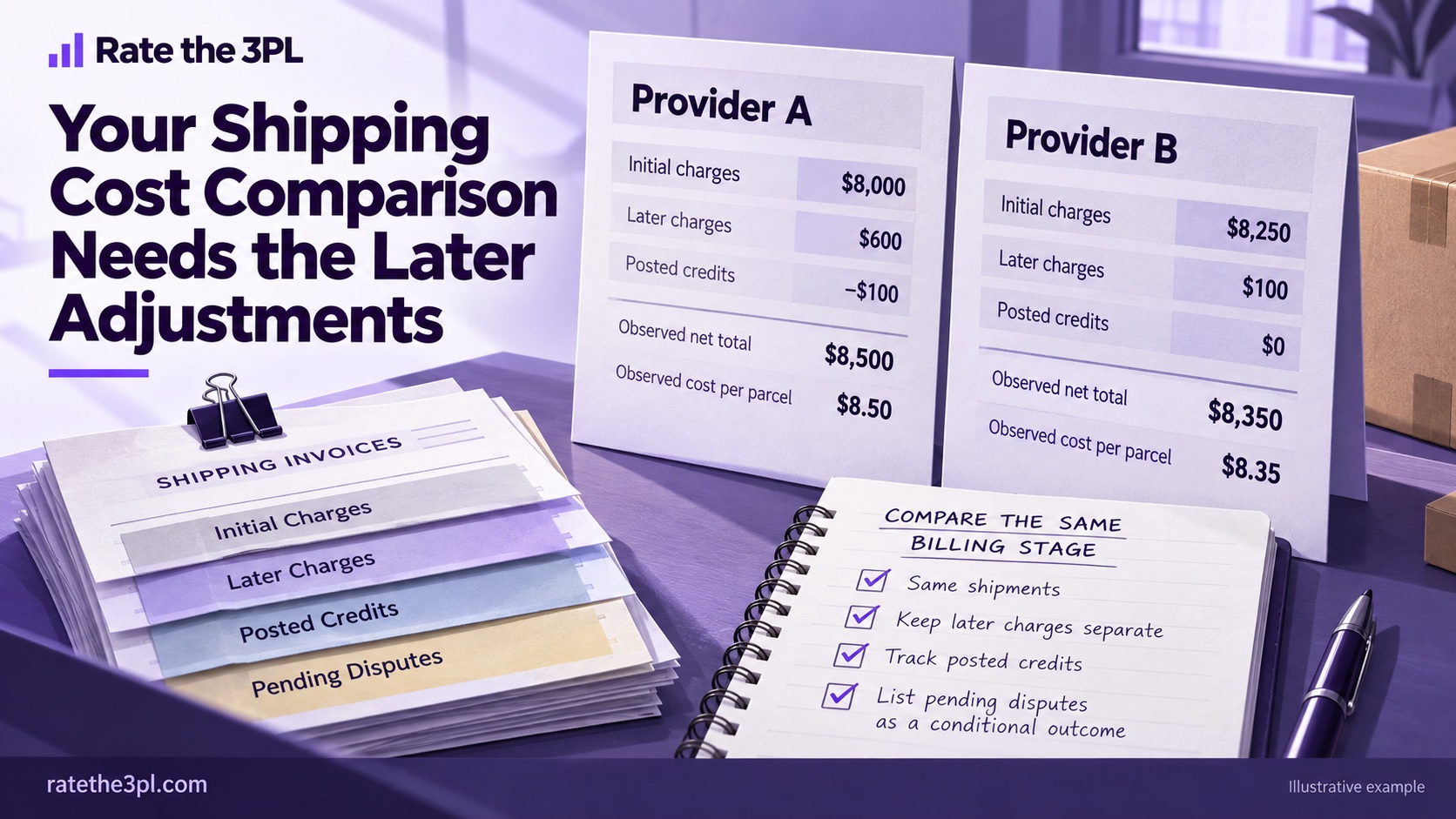
A shipping dashboard shows one 3PL at a lower cost per parcel. Before treating that as a price advantage, ask whether both totals include the same stage of billing. One may show initial label charges while the other includes later adjustments.
The useful comparison follows a defined group of shipments over time. It does not divide whichever charges arrived this week by whichever orders shipped this week and assume the result measures the same thing.
Keep the records connected
FedEx’s U.S. billing resources describe electronic invoicing, adjustment requests and payment remittance as distinct parts of its billing process. That supports keeping charges and their later resolution linked; it does not guarantee that a particular requested adjustment will be approved. FedEx billing resources.
Ask your 3PL which references connect each line to the shipment and which date it uses in reporting. Confirm whether its displayed transportation amount is estimated, charged, adjusted or final under its own reporting convention.
Follow one cohort through the bill
Original illustrative comparison: both providers shipped 1,000 parcels with equivalent service requirements. All figures are invented, and only the listed shipping charges are included.
| Stage | Provider A | Provider B |
|---|---|---|
| Initial charges | $8,000 | $8,250 |
| Later charges | $600 | $100 |
| Posted credits | −$100 | $0 |
| Observed net total | $8,500 | $8,350 |
| Observed cost per parcel | $8.50 | $8.35 |
A first appears $250 cheaper. After the listed adjustments, B is $150 cheaper. Suppose A also has $200 under dispute: that pending amount is not a posted credit. If approved in full, A’s total would become $8,300. Show that as a conditional outcome, not today’s result.
Separate the reason from the amount
Classify adjustments by the carrier’s actual description and the provider’s contractual treatment. Keep transportation changes separate from warehouse fees. Do not assume a charge is fuel, demand or a pass-through simply because it appeared during peak season.
Ask for the supporting line item when a description is unclear. A generic surcharge category may be enough for a summary, but it is not enough to verify the applicable shipment, charge basis and period.
Compare cohorts with similar maturity
Record when the initial shipments occurred and when the comparison was refreshed. A newer group may have fewer posted adjustments merely because less time has elapsed. Choose a review interval supported by your actual billing experience, and disclose charges still unresolved.
This is a management comparison, not a prescription for accounting recognition. Finance should determine the treatment required for the books. The editorial point is to avoid mixing pending and posted amounts in a provider ranking.
Request a reproducible export
A useful file includes shipment reference, shipment date, charge date, charge type, amount, credit reference and dispute status. Reconcile the export to the billed totals before using it to evaluate the provider.
The best quote review continues after labels are purchased. It asks whether the promised economics survive the actual billing sequence, while keeping unresolved questions visible.
Related reading
Sources
- FedEx describes electronic invoicing, adjustment submission and payment remittance — accessed 2026-10-09.