
A rush-shipping request often arrives as a single question: can we afford the faster service? The useful number is the change in cost from the original plan, together with evidence that the faster option can still achieve the needed arrival. A premium label bought after the relevant pickup may fail that test before price matters.
Define the outcome before the upgrade
Record the required arrival date, destination, parcel details, warehouse readiness and latest usable handoff. Ask for the specific service commitment for that shipment. A service name alone is not a confirmed arrival promise.
The UPS US service-guarantee page sets out service-specific guarantee availability and adjustments. Its terms should be checked for the relevant shipment date. Do not assume every service has the same guarantee or book a refund as certain income. This article uses no current carrier price or guarantee payout in its model.
Calculate the difference on a consistent basis
Here is an original, fictional quote comparison for one order. All amounts are assumptions, not carrier or 3PL rates. Transportation figures are assumed to include applicable charges for the same parcel; warehouse rush handling is separate.
| Cost line | Standard plan | Upgrade plan |
|---|---|---|
| Transportation | $8 | $23 |
| Ordinary warehouse work | $4 | $4 |
| Extra rush handling | $0 | $3 |
| Total | $12 | $30 |
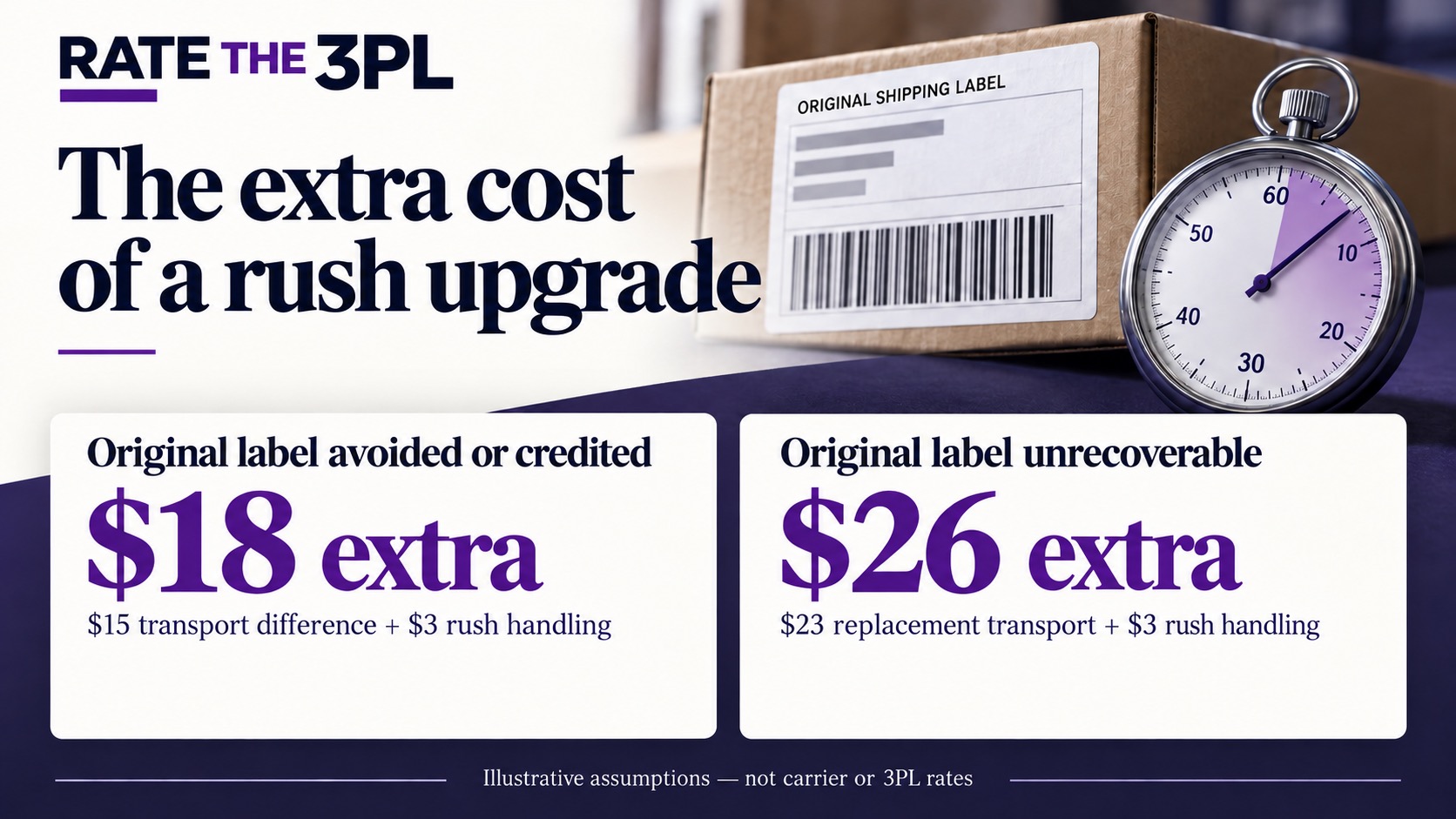
The upgrade costs $18 more: $15 extra transportation plus $3 extra warehouse work. It does not cost an additional $30, because the original $12 was already part of the plan. But that subtraction is valid only if the original charges remain avoidable or credited as assumed.
Test the label that was already purchased
Suppose the original $8 transportation charge cannot be recovered and the replacement still costs $23. Total spend becomes $38: the old $8 plus the new $23, ordinary work of $4 and rush work of $3. Relative to the original $12 plan, the additional spend is now $26.
That sensitivity test is why the quote needs an explicit old-label treatment. Ask whether the first charge was incurred, whether a credit is eligible, who requests it and where it will appear. Do not count both an avoided charge and a refund for the same label.
Put an approval rule around the result
For 100 comparable upgrades, the first scenario adds $1,800; the unrecoverable-label scenario adds $2,600. Neither total predicts your business. It shows how a small assumption changes a batch approval.
Define who can approve the extra cost and which customer outcome justifies it. If the required arrival is no longer achievable, escalation should offer an honest alternative rather than spend automatically. Keep goodwill choices explicit; they need not pretend to be profitable shipping decisions.
When reviewing the invoice, match actual transportation, rush labor and credits to the authorized case. A useful upgrade policy controls both the promise and the incremental spend. It should never depend on a refund that nobody has confirmed.
Related reading
Sources
- UPS US Service Guarantee — accessed 2026-10-22.