
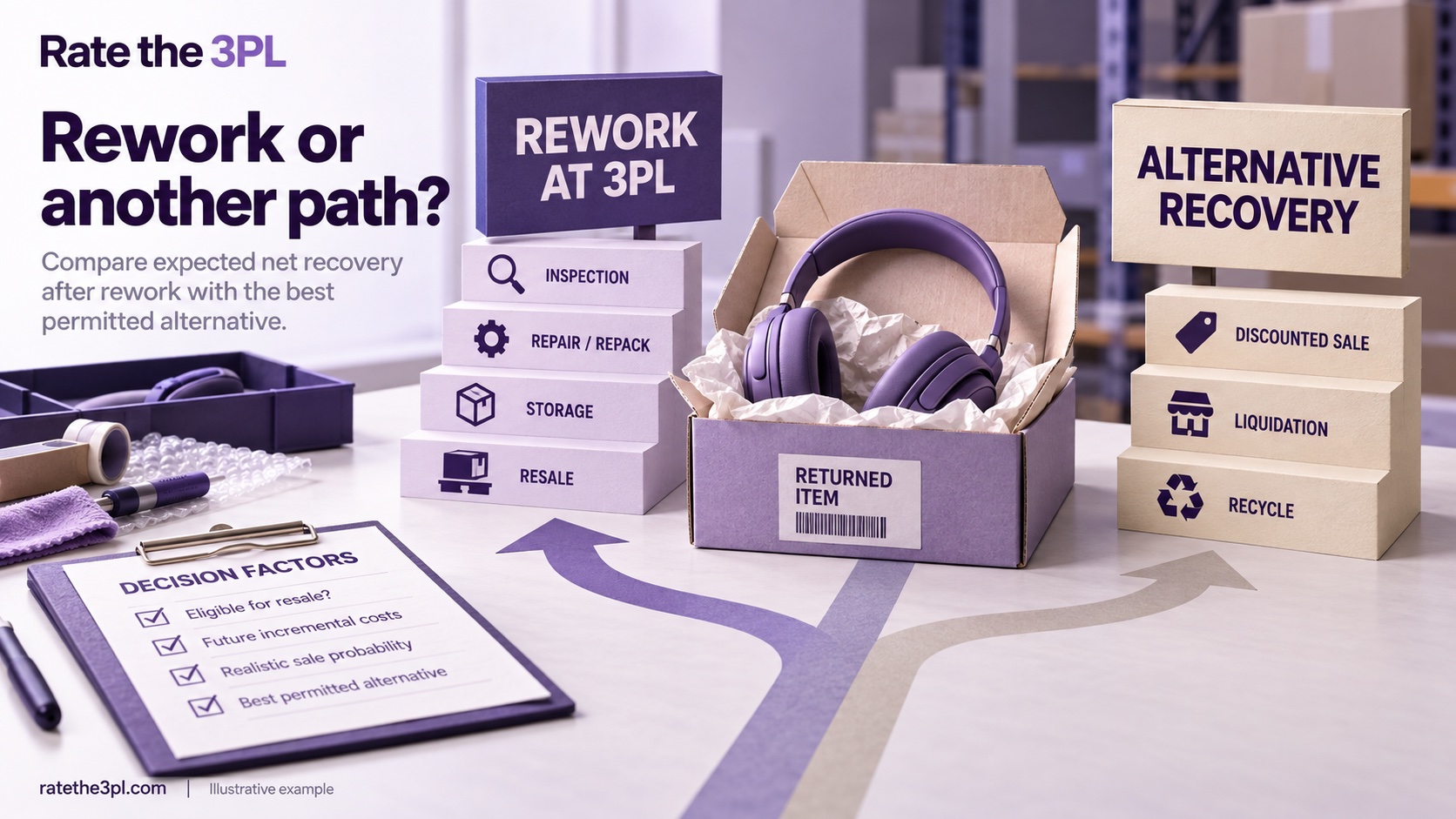
A returned item can look too valuable to give up on. But sending every unit through inspection, repacking and storage can spend more than the inventory eventually recovers.
The practical question is what the next decision earns or costs. Once a return has reached the warehouse, evaluate the work still ahead. Keep costs already incurred visible in total return reporting, but do not charge them again only to the rework option when they are common to every remaining choice.
Put eligibility before economics
First determine whether the product may safely and legitimately be offered for resale, and in what condition. The calculation below concerns an ordinary, nonregulated item that has passed the applicable checks. It is not a recommendation to rework recalled, unsafe or otherwise restricted goods.
Inventory status needs to reflect that separation. Shopify documents unavailable inventory as including quality-control and other holds. A profitable-looking recovery calculation is not a quality release. Shopify inventory states
Build the decision from future cash flows
Our illustrative item would recover $24 if sold after the future selling and fulfillment costs included in that figure. The assumed chance of selling within the decision period is 75%. Rework costs $5, inspection $2 and incremental storage $1 per unit. An alternative permitted recovery route yields $7 net.
Expected rework recovery is 0.75 × $24 − $5 − $2 − $1 = $10 per unit. Against the $7 alternative, rework has a $3 expected advantage under these assumptions.
These are invented scenario inputs, not quoted 3PL rates or observed resale performance. The point is to expose the variables a brand needs to supply.
| Assumed chance of sale | Expected recovery after $8 future costs | Difference from $7 alternative |
|---|---|---|
| 50% | $4.00 | −$3.00 |
| 62.5% | $7.00 | $0.00 |
| 75% | $10.00 | +$3.00 |
The break-even probability is ($7 + $8) ÷ $24 = 62.5%. If the actual sale probability is lower, the example favors the alternative. We assume zero residual recovery for unsold reworked units and no extra disposal cost; change those assumptions when they do not fit.
Avoid double counting the refund
A customer refund already owed under your policy is not automatically a new cost caused by choosing rework. Nor does the original product cost disappear from your financial records. Keep the decision model separate from the full profit-and-loss view: one compares choices from here; the other explains the entire order's economics.
Request the exact charging unit from the 3PL. A batch minimum, hourly rework charge or additional storage period can change the result. Ask what happens to units that fail inspection before assuming every unit incurs every step.
Turn the model into an operating rule
Group products by condition and likely recovery, then agree which cases the warehouse may process automatically and which require approval. Set a review date for slow-moving reworked stock. Otherwise, a model based on a short selling period can turn into an indefinite storage bill.
Use your own evidence for sale probability and net realization, preserving unknowns rather than filling them with optimism. A small pilot can help supply those inputs later, but none was conducted for this article. The immediate value is a decision rule that can explain why one returned item deserves further work while another does not.
Related reading
Sources
- Quality holds and inventory availability — accessed 2026-10-05.