
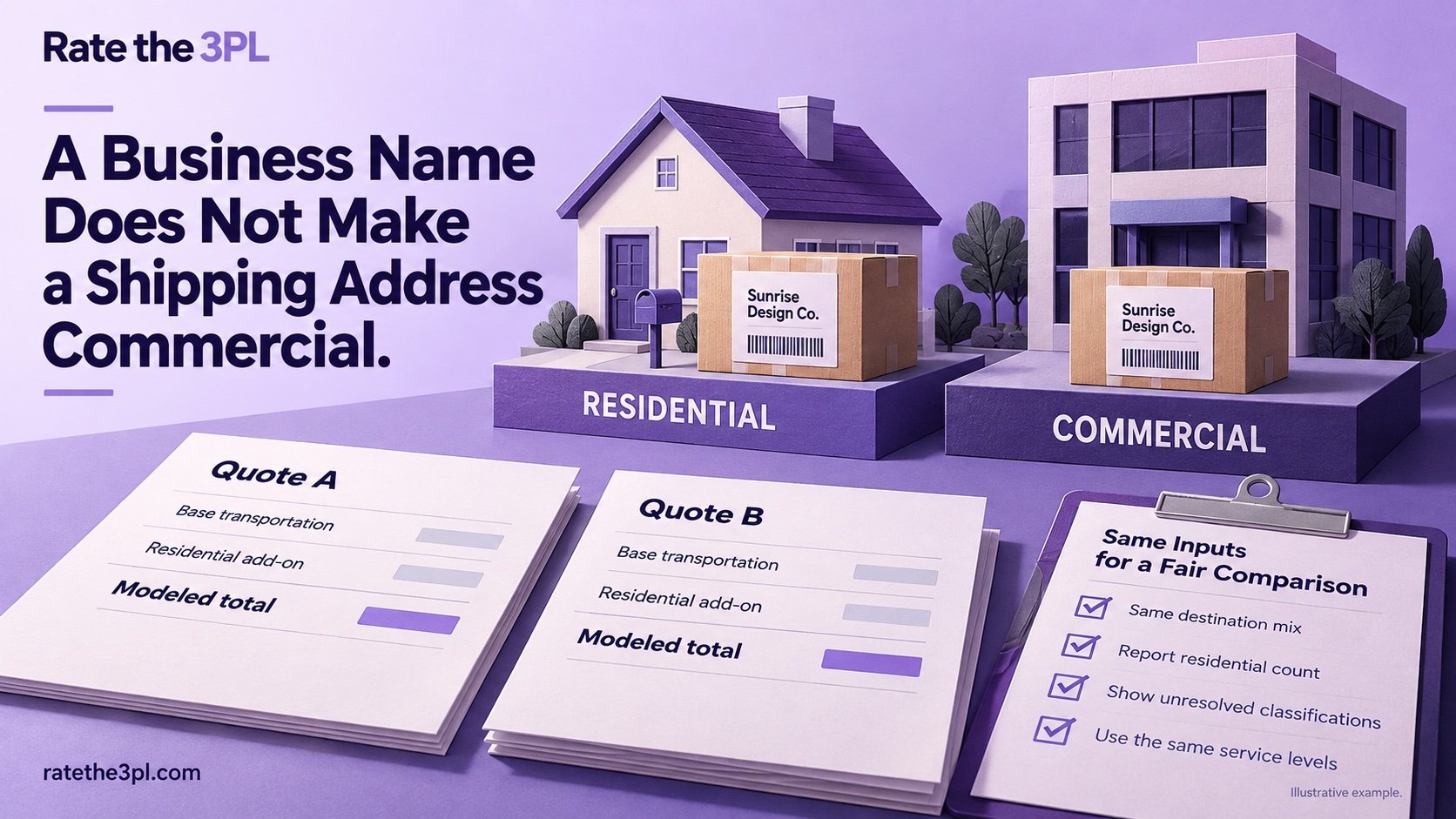
A wholesale order can go to a home-based business. If a quote treats every business-named recipient as commercial, it can understate shipping cost before a single warehouse fee is compared. The right starting point is the destination mix, not the sales channel label.
UPS’s US correction guidance includes homes and home-based businesses in residential areas in its residential-delivery description. It describes classification tools for established UPS delivery addresses. This does not establish another carrier’s rules or guarantee classification for every address.
Hold the shipments constant
The following original calculation uses invented costs, not UPS rates or a provider quote. Assume 1,000 parcels with identical base transportation totaling $7,000. An illustrative $4 residential add-on applies to each residential parcel. No fuel, peak, warehouse or other charge is modeled.
| Assumed residential parcels | Base | Residential component | Modeled total |
|---|---|---|---|
| 100 | $7,000 | $400 | $7,400 |
| 300 | $7,000 | $1,200 | $8,200 |
The $800 difference comes entirely from the classification assumption. It is not a demonstrated difference in provider pricing. On 1,000 parcels, the mismatch changes modeled cost by $0.80 per parcel.
Do not call visibility a saving
Correct classification may move a valid charge into the initial estimate instead of a later adjustment. That improves budgeting without reducing the underlying service charge. When evaluating an address tool, separate fewer classification surprises from fewer genuinely avoidable charges.
A claim that a tool “saved” $800 would be unsupported by this example. The model only reveals $800 that the first assumption omitted. Real savings require evidence of changed payable costs after tool fees, exceptions and contractual treatment.
Give both candidates the same input
Prepare a representative, appropriately protected destination sample with the fields needed for quoting. Ask each candidate to report its residential count, unresolved classifications, service assumptions and treatment of later changes. Use the same sample and date for both.
If the counts differ, investigate before ranking the totals. Do not force an unknown address into the cheaper category. Request the classification source and an explanation of how unresolved records are handled at label creation and billing.
Keep fee categories separate
Residential treatment, address correction, delivery-area charges, fuel and demand charges are different questions. This article does not assert a current amount for any of them. Ask which can apply together under the relevant carrier service and contract, and how the 3PL bills them. Do not add fuel to an assumed fee without confirming the applicable rule.
A useful quote scorecard records both the price and the population it prices. Once destination classifications are comparable, evaluate the transportation proposal alongside warehouse charges. Until then, the cheaper total may simply describe a different set of assumptions.
Related reading
Sources
- UPS US shipping charge corrections — accessed 2026-10-19.