
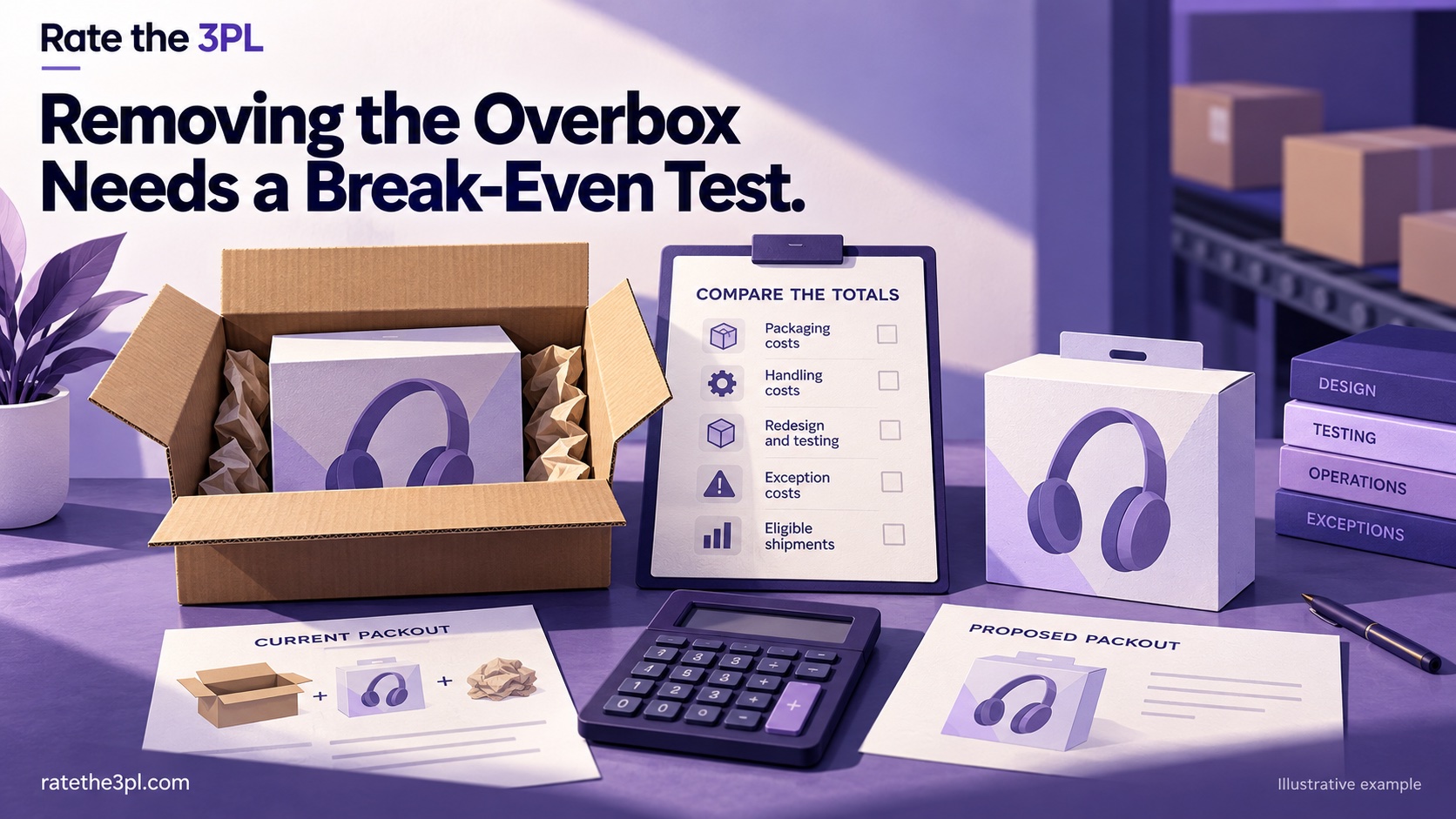
The easiest packaging saving to describe is a box you no longer buy. The harder question is whether the product package can take over the work that box performed—and whether enough eligible shipments remain to repay the change.
Ask your 3PL for two packout specifications, not a blanket instruction to stop overboxing. One describes the current materials and work. The other describes the proposed product package, closure, label position and exceptions. Price both against the same order mix.
Eligibility comes before the savings column
Amazon’s Ships in Product Packaging program describes shipping eligible products in their own packaging and includes testing and certification steps. Its requirements establish a program-specific approval path; they do not establish that any attractive retail carton is ready for every carrier or every sales channel. Amazon Ships in Product Packaging.
For independent 3PL shipments, obtain the relevant carrier, product and packaging requirements. Do not count an Amazon program incentive unless the exact products, enrollment and applicable terms support it. The model below assumes no incentive at all.
A deliberately simple calculation
Our original desk model uses invented costs to isolate the decision. Assume removing an overbox avoids $0.70 in material and $0.20 in handling per eligible shipment, but strengthening the product package adds $0.35. Assume $3,300 of one-time design and testing work.
| Modeled item | Amount |
|---|---|
| Avoided material and handling per eligible shipment | $0.90 |
| Added product-package cost | $0.35 |
| Net saving before exceptions | $0.55 |
| One-time project cost | $3,300 |
| Eligible shipments to recover that cost | 6,000 |
The recovery volume is $3,300 divided by $0.55. At 2,000 eligible shipments a month, simple payback is three months. If only half of 2,000 monthly shipments qualify, it becomes six months. Total order volume is not the same as eligible volume.
Give exceptions their own row
Suppose, as a sensitivity test rather than a prediction, exception handling averages another $0.15 across eligible shipments. Net savings fall to $0.40 and recovery requires 8,250 shipments. At 1,000 eligible shipments a month, that is 8.25 months.
Replace these invented figures with quotes and measured trial results. Include damage, replacement materials, multi-item orders that still need an outer container, gift orders and products whose packaging changes again. Do not assume shipping charges fall in proportion to the cardboard removed; rerate the finished dimensions under the actual agreement.
Set the release rule with the warehouse
Ask who selects eligible orders, how exception products are identified and what happens when approved packaging runs out. Keep a documented fallback packout. A proposed trial should evaluate product protection and execution as well as unit cost; no packaging test was performed for this article.
Approve the change when the eligible volume and complete savings support it. If the project only pays back after assuming every order qualifies, the business case needs another pass.
Related reading
Sources
- Amazon Ships in Product Packaging eligibility and certification — accessed 2026-10-17.