
Put February on the rate-review calendar
FedEx's official US rate-change page, updated October 23, 2026, announces a February 1, 2027 change to zone classifications for selected domestic origin-destination ZIP-code pairs. The same page separately lists January rate and fee changes. Do not assume that a January shipping quote remains a complete model for February. FedEx rate changes.
The announcement does not establish which of your orders will cost more, less or the same. It is a reason to request a second calculation using the applicable zone information when available. No end date for this change is stated in the reviewed announcement.
Keep the shipment file fixed
Ask each 3PL to price an identical file containing origin ZIP, destination ZIP, service, billed weight and package characteristics. Use the actual warehouse origin, not the provider's headquarters. Record the account or commercial arrangement underlying the quote.
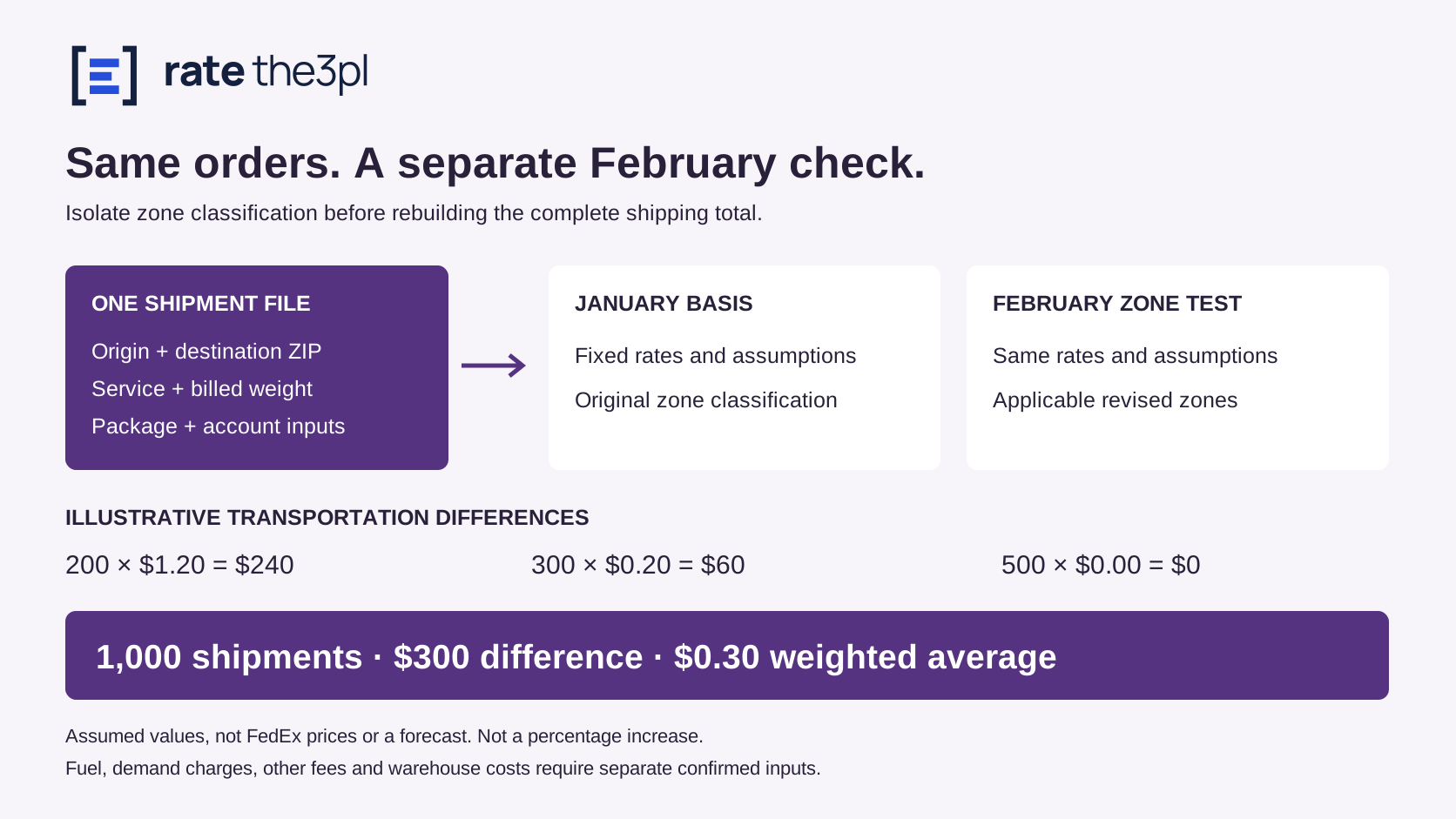
For the zone comparison, hold the January rate basis and other assumptions constant, changing only the applicable zone classification. Separately calculate any other changes needed for a realistic February total. This makes the isolated comparison useful without pretending it is the complete invoice.
A small model shows the question to ask
We calculated three hypothetical cohorts below. The amounts are assumed transportation-charge differences, not FedEx prices, forecasts, identified affected ZIP codes or provider quotes.
| Hypothetical cohort | Shipments | Assumed difference per shipment | Subtotal difference |
|---|---|---|---|
| A | 200 | $1.20 | $240 |
| B | 300 | $0.20 | $60 |
| C | 500 | $0.00 | $0 |
| Total | 1,000 | $0.30 weighted average | $300 |
The calculation is count multiplied by the assumed difference for each cohort, then summed. The average is $300 divided by 1,000 shipments. It is not a percentage increase: that requires a verified starting spend.
The example also shows why counting affected orders is insufficient. A smaller cohort can drive most of the dollar movement. Request both the changed-order count and the cost contribution by lane, using your own verified inputs.
Rebuild the total without double-counting
After isolating the zone effect, add the other applicable transportation components under their confirmed rules. Fuel is a separate calculation; demand charges and other fees may have their own criteria. Do not apply a guessed fuel percentage to the illustrative table and call it a carrier forecast. Storage and picking charges belong in the broader 3PL comparison, outside this isolated transportation calculation.
Ask whether the 3PL uses carrier-account rates, its own rate card or another billing arrangement. A carrier change does not prove that the same amount passes through to the brand.
Use an unresolved-input list
If revised zone information or account pricing is unavailable, mark the estimate incomplete and assign a recheck date. Preserve the original quote file and the assumptions used in each revision. A provider should be able to explain why the comparison changed; a buyer should be able to distinguish a new zone, a new rate and a changed order mix before making a warehouse decision.
Related reading
Sources
- https://www.fedex.com/en-us/shipping/rate-changes.html — accessed 2026-10-25