
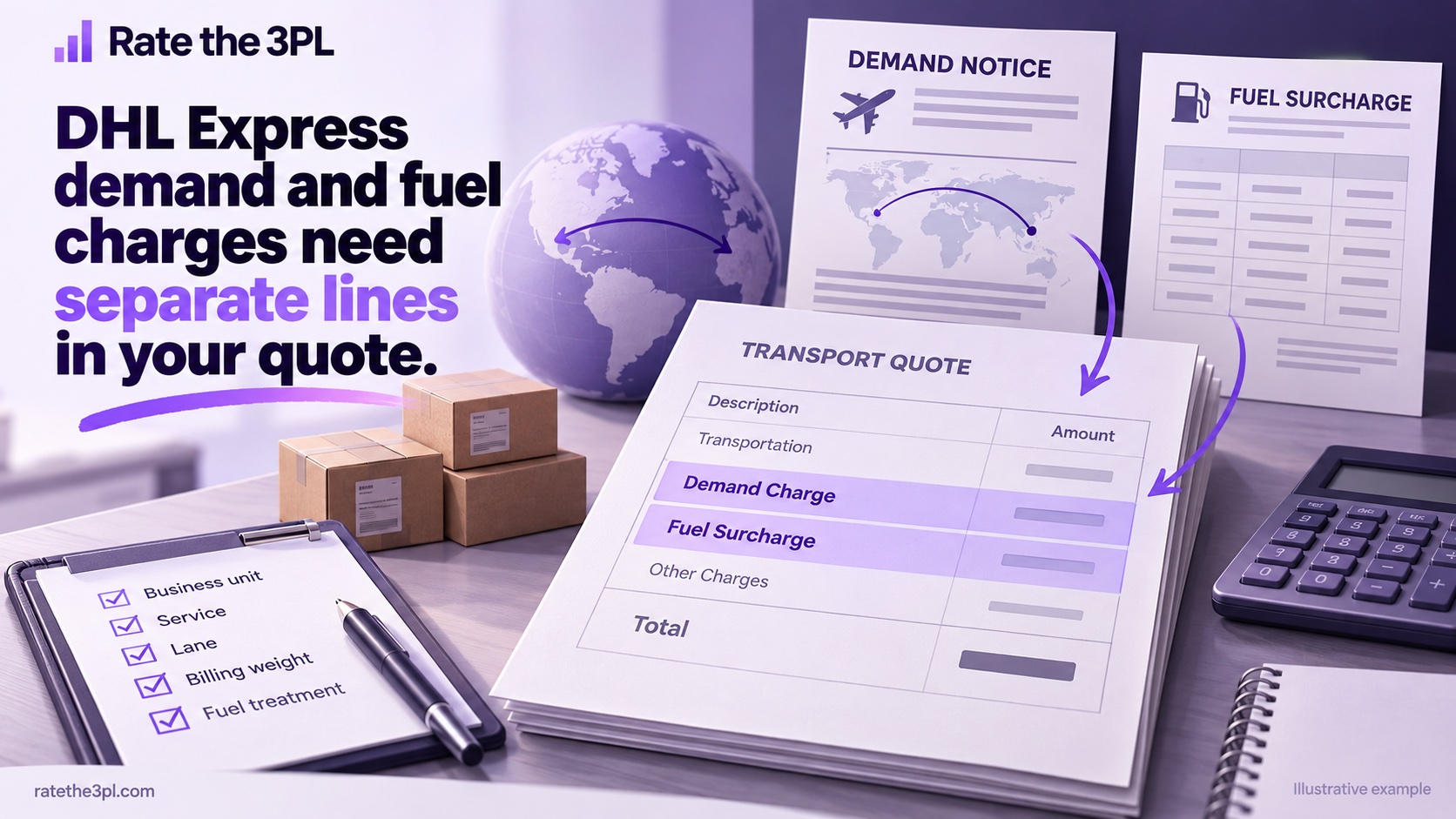
A line called “DHL surcharge” is not enough to evaluate a quote. You need the business unit, service, lane, shipment date and unit of charge. An eCommerce fuel table cannot be substituted for an Express demand notice simply because both carry the DHL name.
DHL Express's U.S. demand notice, updated August 28, 2026, announces a period from October 1, 2026 through February 5, 2027. Its international table uses U.S. dollars per pound of billing weight, varies by origin and destination region, and states that fuel applies. For China/Hong Kong to the Americas, including the United States, its Time Definite International table lists $1.03 per pound. The listed services include DHL Express Worldwide and its import equivalent. These are announced carrier terms, not a quote for your account. DHL Express demand notice.
Isolate the seasonal component
We calculated three hypothetical November China-to-U.S. DHL Express Worldwide import shipments using the published $1.03-per-pound demand rate. The selected billing weights are assumptions, not measurements of actual parcels.
| Assumed billing weight | Demand rate | Demand component before fuel |
|---|---|---|
| 2 lb | $1.03/lb | $2.06 |
| 10 lb | $1.03/lb | $10.30 |
| 30 lb | $1.03/lb | $30.90 |
For a fictional mix of 100 shipments at each weight, the modeled demand component is $4,326: $206 plus $1,030 plus $3,090. The three hundred shipments average $14.42 each for that component alone.
That average should not become a universal parcel surcharge in your forecast. A heavier mix changes it, and a different origin/destination lane can use a different rate. The calculation also says nothing about transportation rates, customs charges or warehouse work.
Treat fuel as a separate input
DHL Express publishes dated fuel percentages with separate import and export columns on its U.S. surcharge page. Do not pull one percentage from that page and silently apply it to every service and future week. DHL Express surcharge information.
The demand notice establishes that fuel applies, but the applicable November rate and account treatment still need verification. As a sensitivity exercise only, applying an assumed 30% to the $4,326 demand component adds $1,297.80, producing $5,623.80 attributable to demand plus fuel on demand. This is not a DHL November fuel forecast or an all-in invoice estimate.
Do not add that $1,297.80 again if the provider's quoted seasonal amount already includes it. Ask the provider to identify its fuel-assessment base and whether its presented figures include or exclude fuel.
Compare quotes without mixing warehouse fees
Give both providers the same service, dates and billing weights. Request distinct columns for base transportation, demand, fuel and other applicable charges, then a separate section for pick, pack, packaging and storage. If the 3PL bundles charges, ask for enough explanation to understand the bundle rather than assuming exact pass-through.
The practical decision is whether the quote's inputs match the orders you plan to ship. A smaller headline surcharge can be less useful than a fully explained price with clear scope. Recheck the carrier notice and the account quote before shipment; the notice allows changes with prior notice.
Related reading
Sources
Accessed September 30, 2026. Recheck time-sensitive terms before publication.
- https://www.dhl.com/us-en/home/express/products-and-solutions/products-and-services-overview/surcharges/demand-surcharge.html
- https://www.dhl.com/us-en/home/express/products-and-solutions/products-and-services-overview/surcharges.html