
Start with the correct DHL business unit
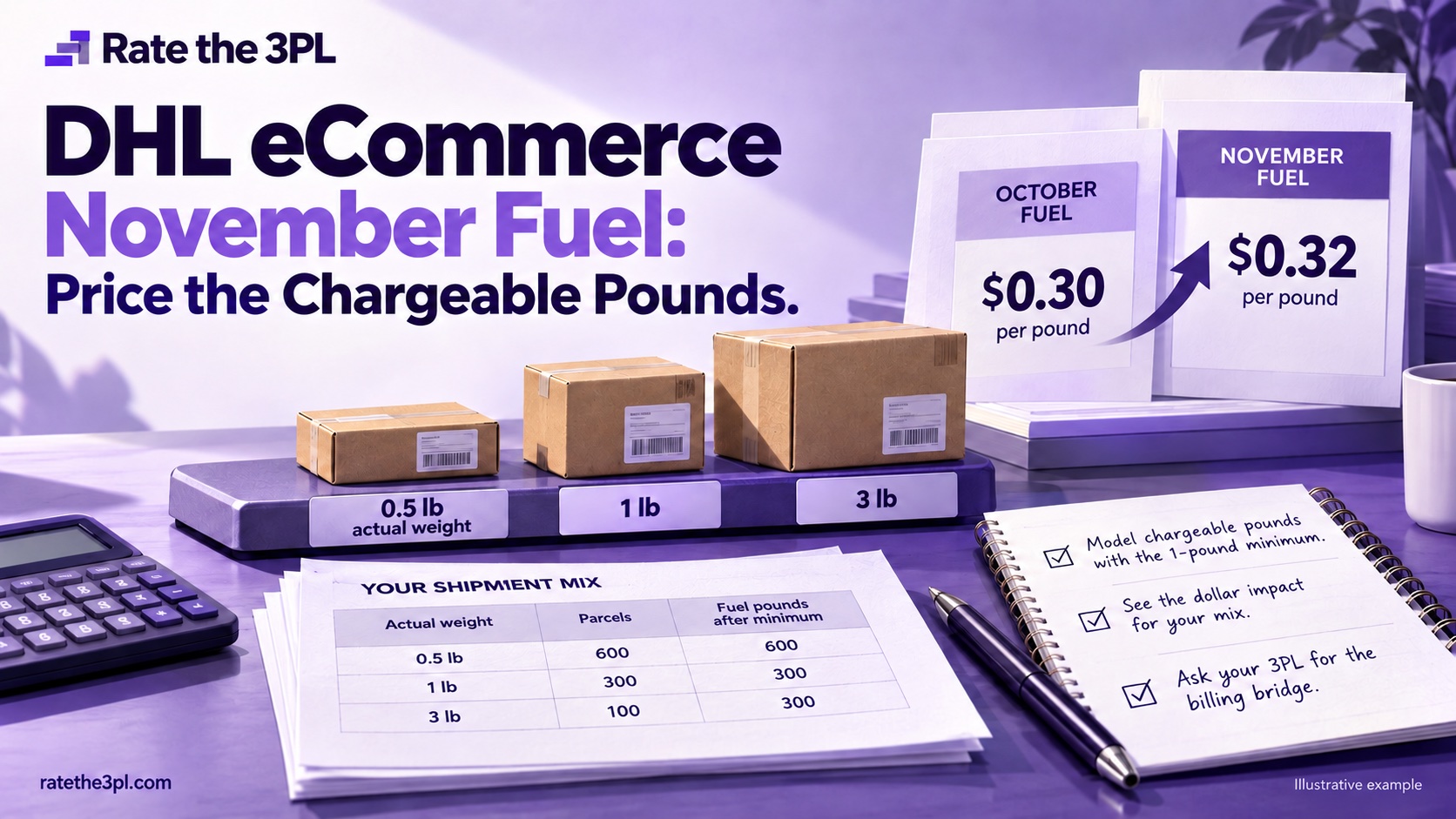
For the United States, DHL eCommerce's published fuel table lists domestic amounts of $0.30 per pound for October 1–31, 2026 and $0.32 for November 1–30, 2026. Domestic packages below one pound in chargeable weight receive a one-pound fuel charge. The listed domestic scope includes Domestic Expedited Max and Expedited and Ground parcel and mail products. This is DHL eCommerce, not DHL Express. The page presents the November table as applicable rates rather than a proposal; it does not display an announcement date. We accessed it October 21. Official surcharge policy.
For a brand comparing fulfillment quotes, the useful question is how its parcel mix translates into the billing basis. A percentage change alone does not show the dollars at stake, and a parcel's product weight is not necessarily its chargeable weight.
Calculate one domestic basket
We calculated an illustrative basket of 1,000 domestic parcels using three assumed chargeable weights. These are already-determined chargeable weights, not scale readings. We apply only the published fuel amounts and minimum; no rounding rule above one pound is inferred.
| Assumed chargeable weight | Parcels | Fuel pounds after minimum | October fuel | November fuel |
|---|---|---|---|---|
| 0.5 pound | 600 | 600 | $180 | $192 |
| 1 pound | 300 | 300 | $90 | $96 |
| 3 pounds | 100 | 300 | $90 | $96 |
| Total | 1,000 | 1,200 | $360 | $384 |
The isolated change is $24 for this basket, or 2.4 cents per parcel on average. The basket's assumed chargeable weights total 900 pounds before the minimum. Applying the two-cent difference to that unadjusted total would produce $18 and understate this example by $6.
This calculation is not a carrier quote or a prediction of a 3PL invoice. It excludes base transportation, peak charges, delivery-area charges, warehouse labor, taxes and account-specific arrangements. The weights and counts are invented to show the effect of the minimum, not to represent typical ecommerce traffic.
Ask for the billing bridge
Give your fulfillment partner the same three rows and ask for a sample invoice calculation. Request the chargeable weight used, the service selected, the shipment date that governs the rate and the agreement governing pass-through. If shipping is bundled into an all-in price, ask whether and when this published change affects that price.
Do not assume that the difference must appear as a separate fuel line. The contract may use a different commercial arrangement. What matters is whether the partner can explain the amount you will pay and distinguish a carrier component from its own charge.
Keep the other changes outside this calculation
The official page separately identifies peak and delivery-area surcharges and links to a peak notice. The fuel example above does not include those charges. It also does not apply fuel again to them. International products have a separate column and are outside this domestic basket.
Before accepting a revised quote, replace the hypothetical counts with your shipment file and obtain the account-specific weight and charging rules. Recheck the official table near shipment: the policy says terms can change. A clean reconciliation should show the original basket, each applicable change and the final billed amount, with warehouse charges kept separately visible.
Related reading
Sources
Research accessed October 21, 2026.
- https://www.dhl.com/us-en/home/ecommerce/business-help-center/surcharge-policies.html