
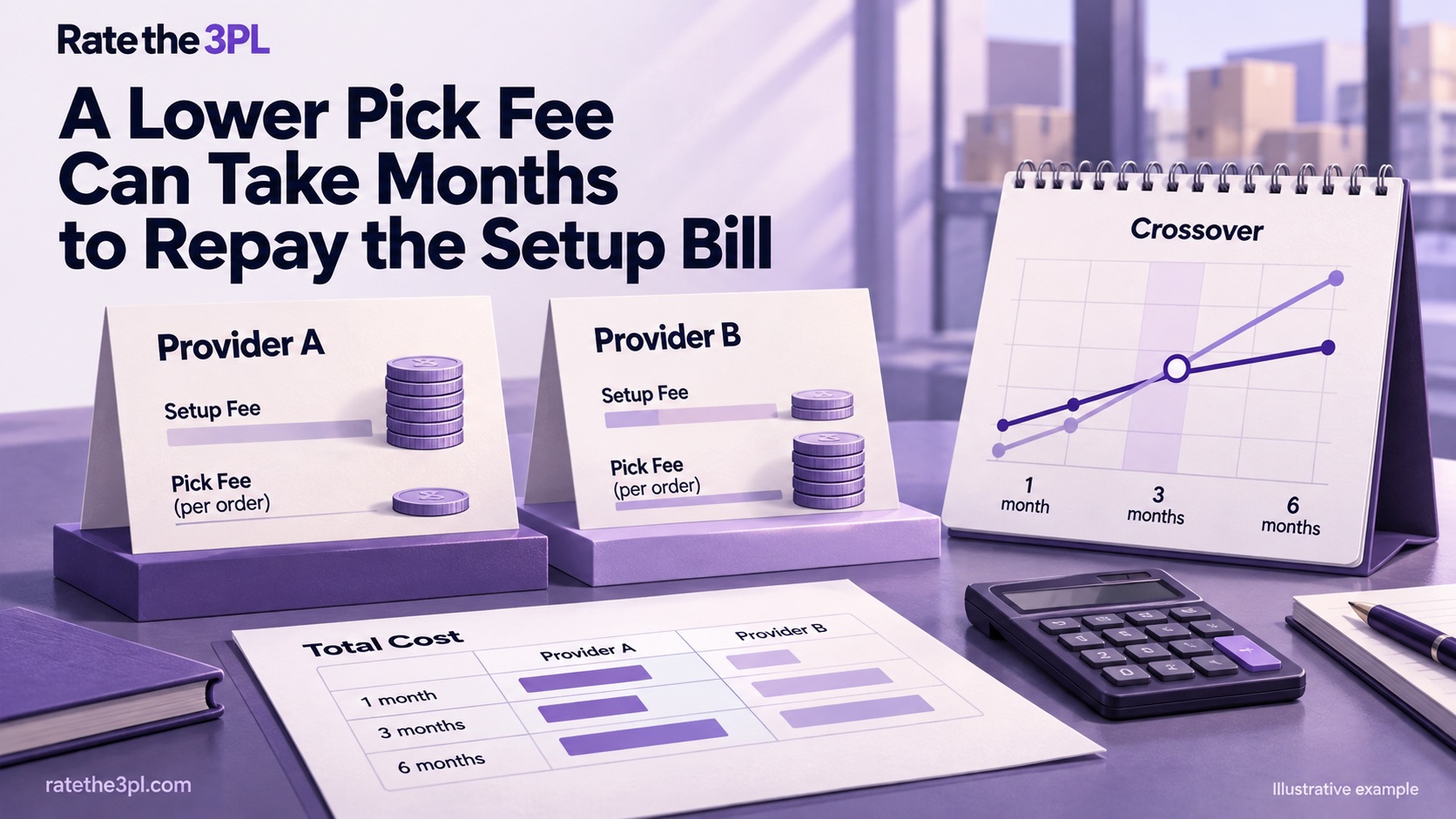
One provider offers a smaller handling fee but a larger onboarding bill. Another starts cheaply and charges more per order. Neither number answers which proposal costs less for your business unless you choose a volume and a time horizon.
Put one-time implementation charges beside the recurring costs they accompany. Ask what setup includes: configuration, data mapping, testing, training or something else. An invoice labeled onboarding is not evidence that two providers are offering the same scope.
Build a comparison with a defined horizon
The SBA’s business-planning guidance separates one-time and recurring startup expenses. We apply that distinction here to a fictional fulfillment purchase; these figures are not market rates. SBA planning guidance.
Illustrative offers: Provider A charges $6,000 setup and $2.20 per order. Provider B charges $1,000 setup and $2.70 per order. Assume the same included handling work, no other differences and 2,000 orders every month.
| Period | A: setup plus handling | B: setup plus handling |
|---|---|---|
| 1 month | $10,400 | $6,400 |
| 3 months | $19,200 | $17,200 |
| 6 months | $32,400 | $33,400 |
A costs $4,000 more after month one but $1,000 less after month six. Looking only at the recurring rate conceals the early cash requirement; looking only at setup conceals the later savings.
Calculate the crossover, then challenge it
The extra setup is $5,000. The assumed per-order saving is $0.50, so 10,000 orders repay that difference. At 2,000 orders monthly, the simple crossover is five months. At 1,000 monthly, it takes ten months.
This is an undiscounted cost comparison, not an accounting amortization schedule or a return forecast. It ignores financing, taxes, growth, minimums, transportation and any other fee. Those omissions must be resolved before using it to select a provider.
Check which savings are real
Apply both proposals to the same order mix. A fee that covers one item is not equivalent to a fee covering an entire multi-item order. Identify exceptions and any monthly minimum before multiplying a headline rate by volume.
If the verified saving is zero or negative, there is no positive fee-saving crossover under this model. The larger setup charge might still buy useful capabilities, but that is a separate argument that needs evidence.
Match the horizon to your plan
For a short launch or uncertain product line, do not assume a multi-year relationship just to make the preferred quote look cheaper. Ask which setup payments are due before testing, whether reconfiguration adds cost and what happens if implementation stops.
Include the merchant’s own implementation work in a separate line where it differs between offers. Keep estimates visibly labeled; an unknown cost should remain unknown until researched.
A good comparison shows the first cash payment, the running totals and the assumptions required for the lines to cross. That gives the buyer a decision to examine rather than a low rate to remember.
Related reading
Sources
- SBA distinguishes one-time and ongoing expenses in business planning — accessed 2026-10-08.