
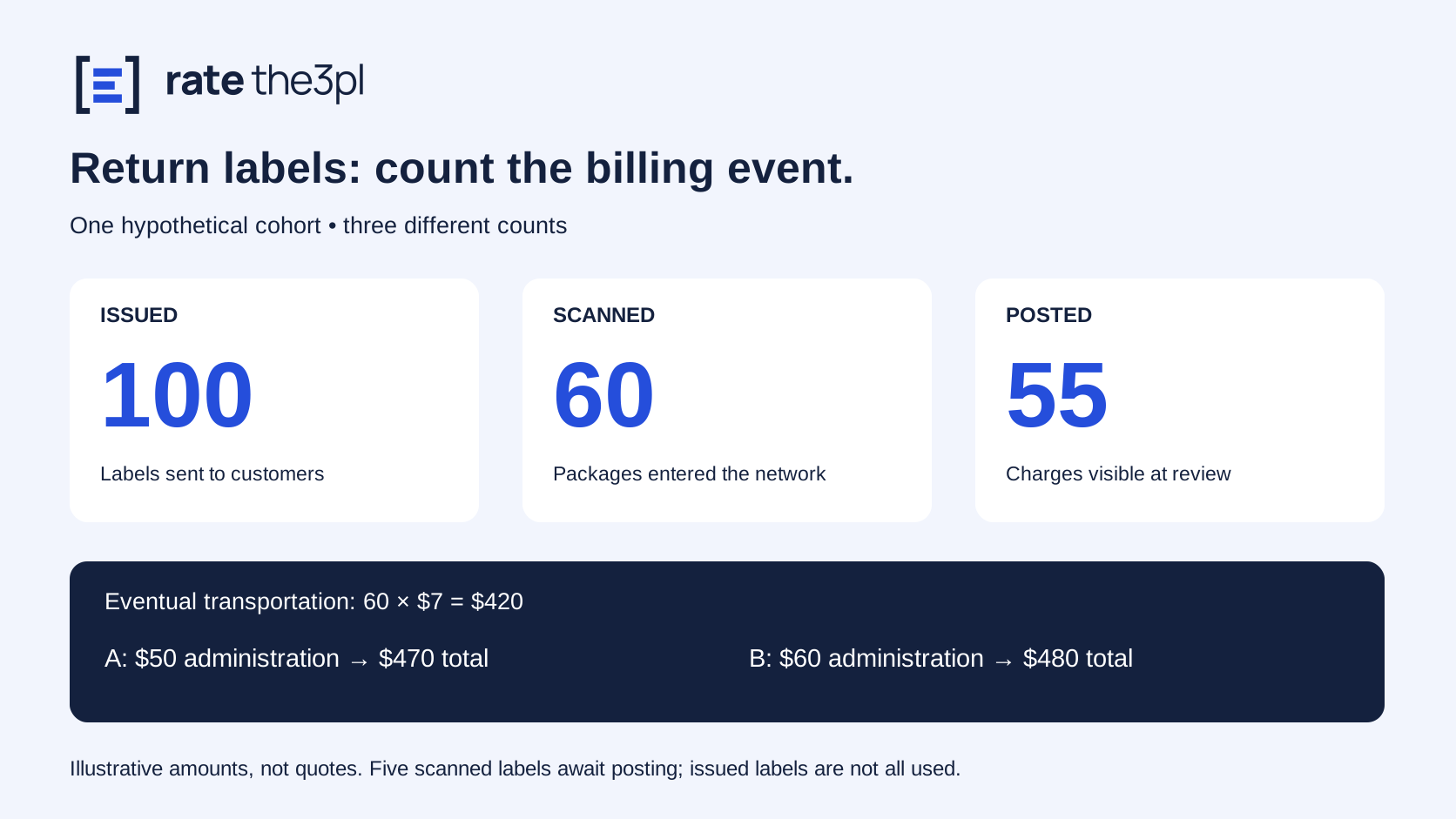
Start with the billing event A brand sends 100 return labels and sees only 60 packages enter the carrier network. A quote that says “return label fee” is too vague to price that month. It might describe transportation charged when used, an administrative service charged when issued, or both.
For return labels created through its documented workflow, Shopify explains pay-on-scan billing: creation does not itself trigger the shipping charge. The final amount can differ from the estimate after the actual package is measured. This is a specific platform workflow, not a universal promise about every 3PL, app or carrier contract.
Build a three-count comparison Our hypothetical month has 100 labels issued, 60 scanned and 55 posted to the billing record by the review date. Five scanned labels are still awaiting a charge in this invented example. Assume every used label ultimately costs $7, solely to make the calculation transparent. Assume Proposal A adds $0.50 per issued label; Proposal B adds $1 per scanned label. These are invented administrative terms, not market quotes.
| Modeled charge | Proposal A | Proposal B |
|---|---|---|
| Eventual transportation: 60 × $7 | $420 | $420 |
| Administration under assumed terms | $50 | $60 |
| Eventual combined amount | $470 | $480 |
At the review date, posted transportation is only 55 × $7, or $385. The remaining modeled $35 is not a new return and should not be counted twice when the five charges arrive. Equally, treating all 100 issued labels as $7 transportation charges would produce $700, overstating this scenario’s eventual transportation by $280.
The five-label posting delay is an explicit modeling assumption. Shopify documents that billing data can arrive at different intervals, but we did not measure a delay distribution. Actual charges may vary by returned package, service and contract.
Find where the administrative comparison reverses With 100 labels issued, A’s administrative fee stays at $50. B equals that at 50 scanned labels. If 40 are used, A’s combined modeled amount is $330 and B’s is $320. If 80 are used, A is $610 and B is $640. No provider wins every usage scenario under these assumptions.
The useful comparison is therefore the relationship between issued and used labels, not a single low per-label figure. Use your own cohort history, including labels used in a later month, before estimating that relationship. Do not turn this invented example into an expected customer return rate.
Ask for a joinable invoice Request label identifier, return authorization, issue date, carrier scan date, charge-posting date, transportation amount, adjustments and the separately named administrative fee. Agree how replacement labels and duplicate requests are handled. A second label created for one customer does not necessarily mean a second parcel traveled.
Match costs to the chosen reporting period and disclose whether the report shows posted charges or an estimate of eventual cohort costs. Reconcile estimates when actual charges arrive. Keep customer return fees separate from provider costs; the amount collected from a shopper is not evidence of what the 3PL paid.
Keep the scope comparable This model excludes receiving, inspection, restocking, disposal, app subscriptions and refund processing. Add those agreed charges when comparing the complete return service. Also verify eligible origins and carriers for the proposed label workflow rather than assuming the platform example applies to your account.
Ask each provider to price the same issued-and-used scenario with its actual billing triggers. That question turns an ambiguous return-label line into a comparison a buyer can audit.