
Put the effective date beside the percentage
A quote that says “annual adjustment” leaves two important questions unanswered: which charges change, and when? Before comparing providers, turn the clause into a dated price schedule. Keep the work assumptions constant so a price change does not get confused with a larger order forecast.
This is especially useful when a warehouse contract and carrier rate changes arrive in the same planning cycle. FedEx's U.S. rate-change page, updated October 23, 2026, announces a package-rate increase effective January 4, 2027. It separately lists other changes with later dates. That announcement does not establish when your warehouse labor price changes or how your 3PL passes transportation costs through. Official FedEx rate-change notice.
Compare two dates using the same workload
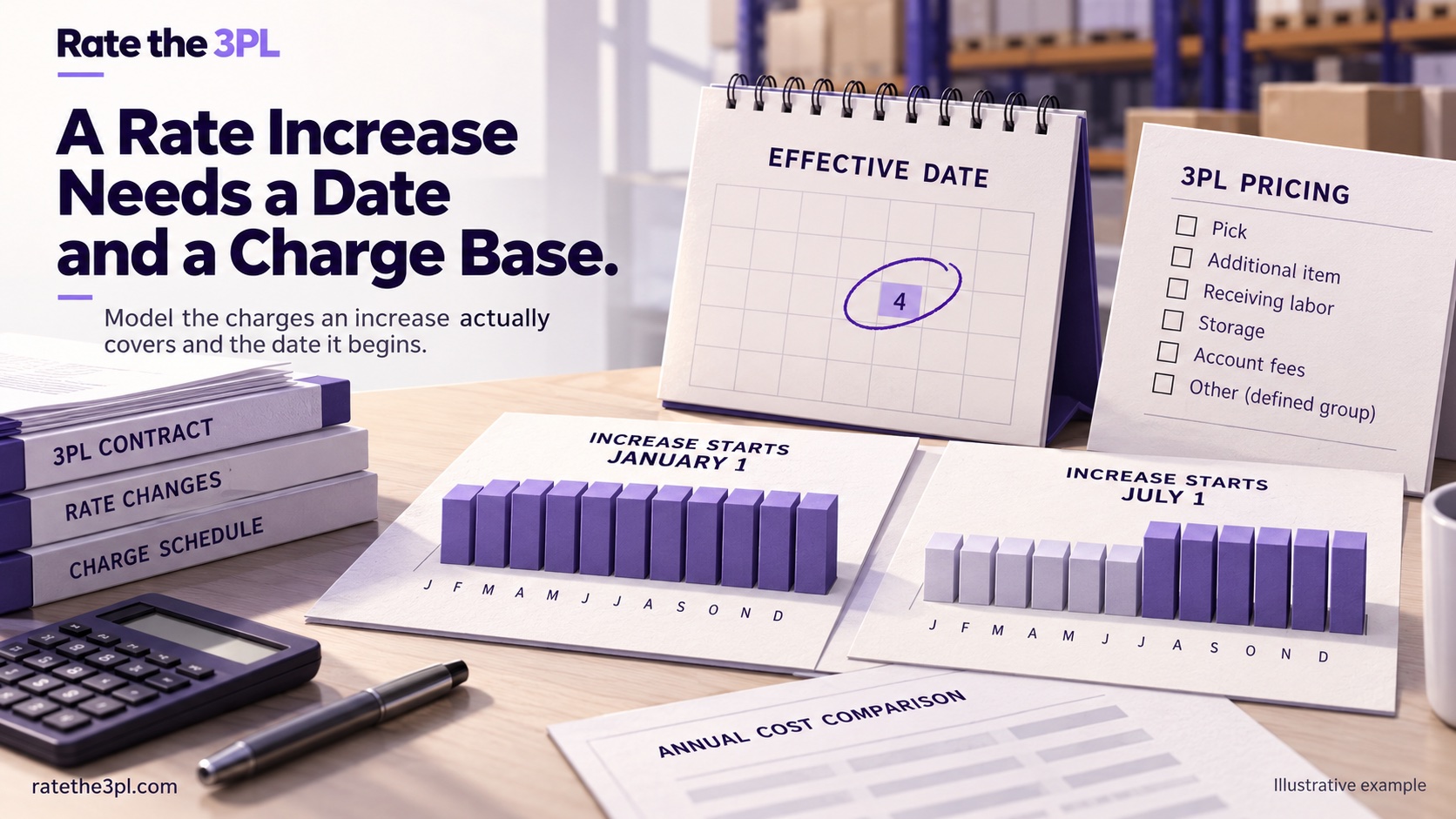
We calculated two hypothetical annual scenarios. Each starts with $10,000 per month of eligible warehouse charges at constant workload. Each has a single 4% increase. Four percent is an invented planning input, not a quoted provider increase or the FedEx increase. Transportation, taxes, storage changes and other fees are excluded.
| Scenario | Months at $10,000 | Months at $10,400 | Annual eligible cost |
|---|---|---|---|
| Increase starts January 1 | 0 | 12 | $124,800 |
| Increase starts July 1 | 6 | 6 | $122,400 |
The difference is $2,400 even though the percentage is identical. The increased monthly amount is $10,000 × 1.04. The second total combines six months at each rate; it is not a full year's spend multiplied by half the percentage without checking timing.
This comparison isolates timing. It does not make the later increase the better contract overall. A provider with different service, minimums or base fees can still cost more, and an actual agreement may allow other changes.
Define the eligible charges before calculating
Request a list of the lines subject to the adjustment: first pick, additional item, receiving labor, storage, account fees or another defined group. Mark fixed-price or excluded lines separately. If the contract refers to an index, ask for the exact series, reference period, cap, floor and method of rounding. Leave these fields unknown until the written terms answer them.
Also ask what happens to work spanning the effective date. The receiving date, service date and invoice date can differ. Have the provider explain the applicable billing event and show a sample line on each side of the boundary. Do not assume a delayed invoice gives you the old rate.
Keep the carrier layer separate
Use a second schedule for transportation. Identify the carrier, service, account price basis, effective dates and contract pass-through mechanism. Fuel, demand charges and base-rate changes are separate categories; they should not be blended into an unexplained warehouse increase. Do not apply a fuel percentage to warehouse charges or every accessorial without a documented basis.
If transportation is bundled, request a bridge from the old bundled price to the new one. The public carrier announcement may explain part of the change, but it cannot confirm the private agreement or every discount.
Ask for a reproducible comparison
Give both candidates the same monthly workload and ask them to reproduce the annual calculation. Save the rate version and effective dates with the result. Then change volume and mix in a separate sensitivity test.
The useful score is a dated cost for defined work. A percentage without its charge base, timing and contract limits is not enough to compare the next year's fulfillment bill.
Related reading
Sources
- https://www.fedex.com/en-us/shipping/rate-changes.html — accessed 2026-10-20