
The percentage is only part of the comparison Two quotes can advertise attractive discounts while pricing different billable weights. If one comparison starts with the scale weight and another starts with a dimensional calculation, the final percentages are not describing the same purchase.
FedEx explains that it uses the greater of dimensional and actual weight and describes a divisor of 139 for U.S., Puerto Rico and international shipments on its dimensional-weight page. Confirm the applicable service, current guide and account terms before using a number in a real quote. FedEx dimensional-weight explanation.
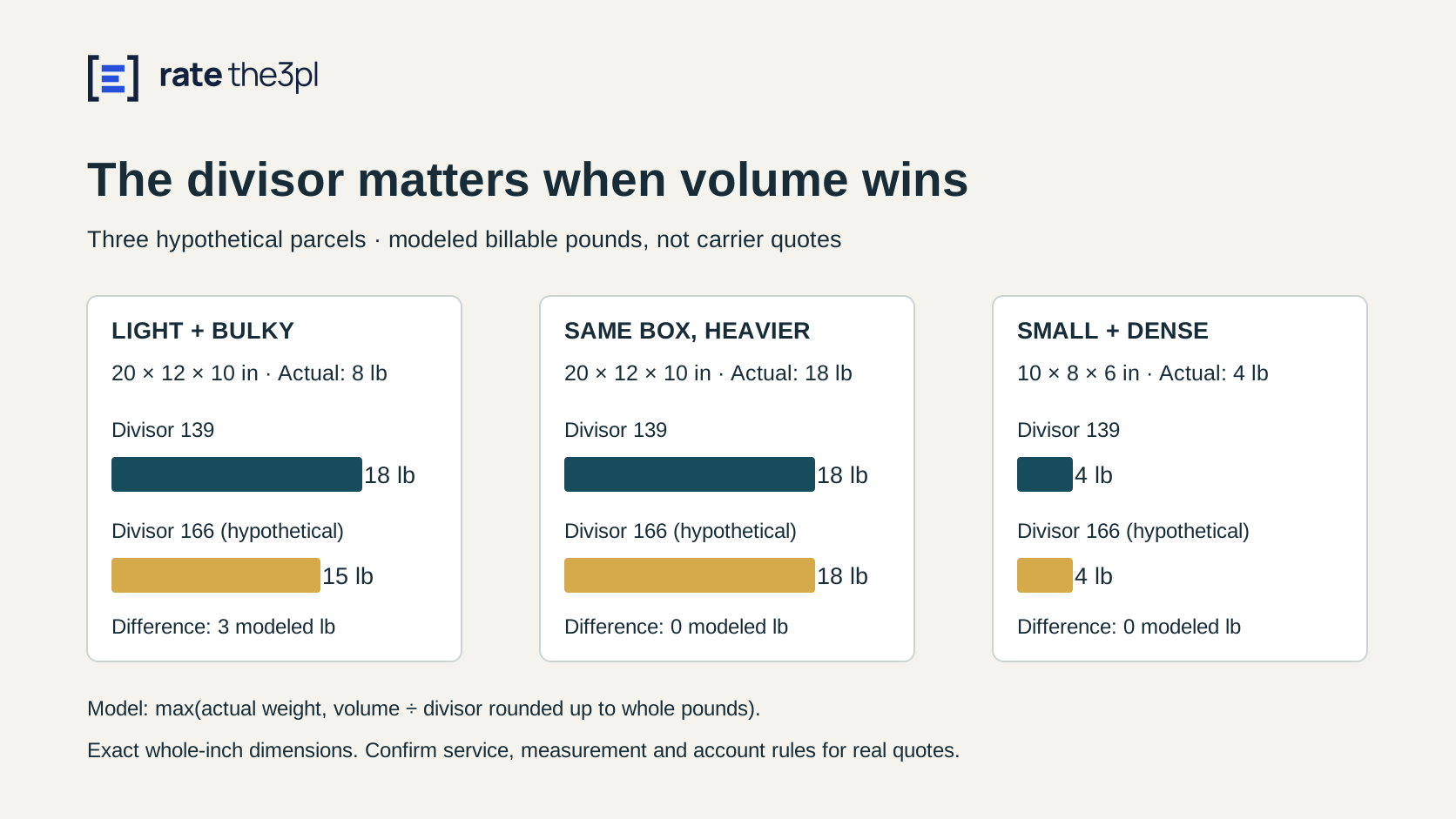
Three parcels expose three different effects We calculated three deliberately chosen, hypothetical parcel cases: a light bulky parcel, the same volume with heavier contents, and a small dense parcel. This is a mechanism test, not a representative shipment sample.
The model compares divisors 139 and 166. The second is only a hypothetical comparison term, not a claimed available FedEx agreement. Dimensions are exact whole inches, dimensional results are rounded upward to whole pounds for this exercise, and modeled billable weight is the larger of that result and actual weight. These assumptions do not replace carrier measurement or billing rules.
| Illustrative parcel | Volume, cubic inches | Actual lb | Modeled lb at 139 | Modeled lb at 166 |
|---|---|---|---|---|
| 20 × 12 × 10 inches, light contents | 2,400 | 8 | 18 | 15 |
| Same dimensions, heavier contents | 2,400 | 18 | 18 | 18 |
| 10 × 8 × 6 inches | 480 | 4 | 4 | 4 |
For the first case, 2,400 divided by 139 is about 17.27; divided by 166 it is about 14.46. Under the stated rounding assumption, the model prices three fewer pounds at 166. The second parcel has the same dimensional calculations, but its actual weight removes that difference. The third is actual-weight controlled under both assumptions.
A weight difference is not yet a dollar saving Suppose, purely to isolate the mechanism, a fictional pricing formula charges $0.50 per modeled pound. The first case would differ by $1.50, and the other two by zero. Real carrier tables are not that simplified formula. Zone, service, minimums, discounts and additional charges can change the result.
For your quote comparison, replace the invented formula with each proposal's applicable rate table. Ask the 3PL to return measured dimensions, scale weight, dimensional weight and the final weight used for pricing on the same historical parcel set. Require any minimum or special handling rule to appear separately.
Find where your own exposure sits Group the results into parcels controlled by actual weight, parcels controlled by dimensional weight, and cases where a different measurement or rounding assumption changes the outcome. A divisor improvement matters most in the second group; a high average discount tells you little about the size of that group.
Also ask who chooses the carton and how packing changes are approved. A favorable divisor does not excuse an unsuitable box, and a smaller box should not be adopted without checking product protection.
The practical scorecard is a matched set of parcel inputs and resulting charges. Prefer a quote you can reproduce over a discount headline you cannot explain.
Further reading
Sources
- Source 1 — accessed 2026-10-28.