
Start with the purchase you must make
A packaging quote often leads with a price per carton. That number can be accurate and still be the wrong basis for choosing a 3PL's packaging option. The commercial decision includes the minimum quantity, setup work, storage and the number of cartons the brand can use before the artwork or product changes.
Ask whether the warehouse buys the stock on your behalf, charges when it arrives or bills only when a carton is used. Establish who owns leftovers and who pays to move or dispose of them. A low unit price attached to a large purchase is different from a higher price paid only as needed.
Compare two deliberately invented options
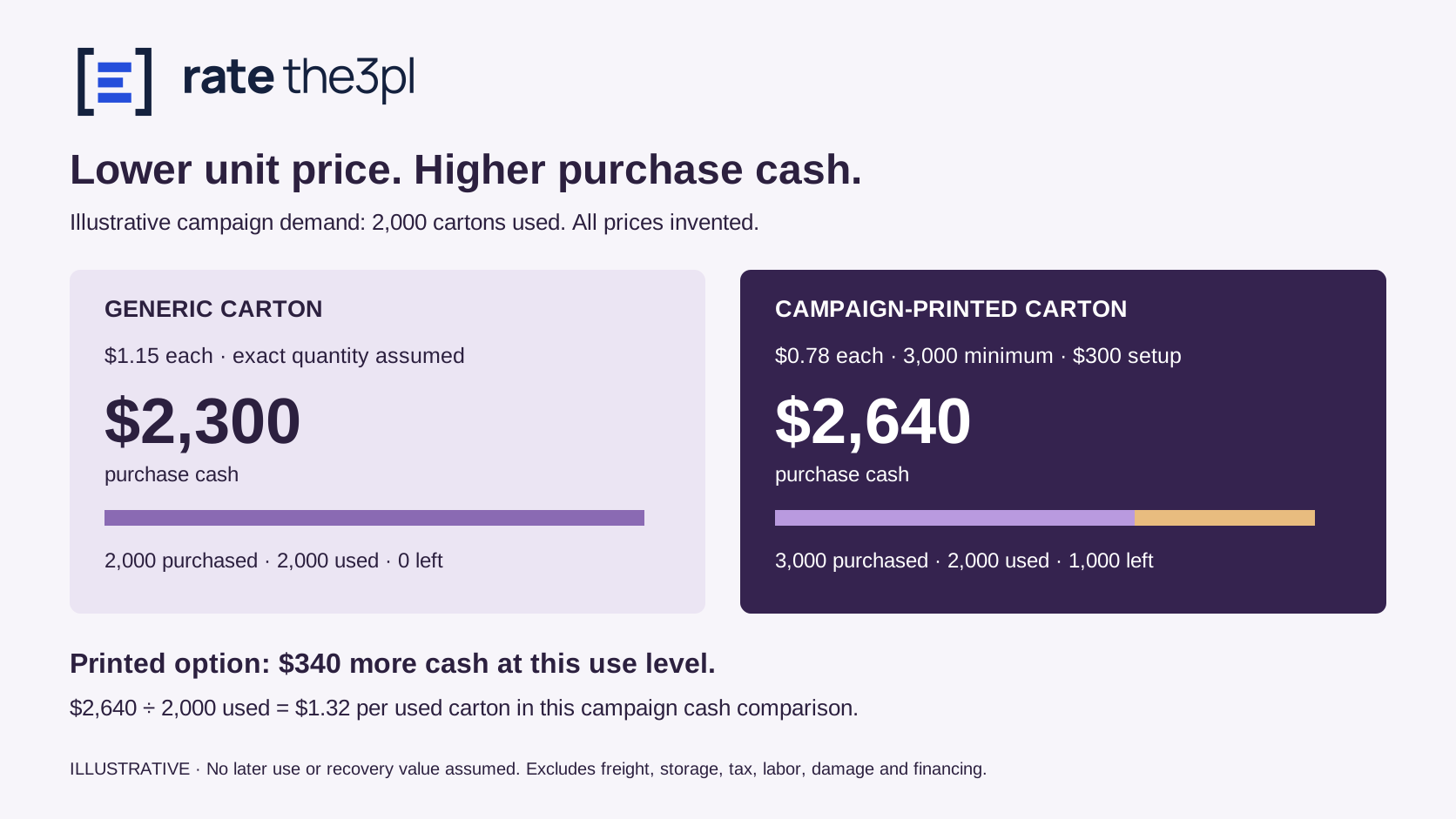
We constructed a simple campaign example. Both cartons are assumed suitable for the same product and shipping method; that suitability must be verified in real life. All prices below are invented, and the calculation excludes freight, storage, tax, packing labor, damage and financing costs.
| Input | Generic carton | Campaign-printed carton |
|---|---|---|
| Price per carton | $1.15 | $0.78 |
| Minimum purchase | Exact quantity needed, assumed | 3,000 |
| Setup fee | $0 | $300 |
| Expected campaign use | 2,000 | 2,000 |
| Purchase cash | $2,300 | $2,640 |
| Unused cartons | 0 | 1,000 |
The printed option requires $340 more cash even though its unit price is lower. Dividing its purchase cash by the 2,000 cartons used gives $1.32 per used carton. That measure is a campaign cash comparison, not an accounting determination of expense or inventory value.
For this scenario only, assume the leftover campaign cartons have no later use or recovery value. If they can be used later, retain their value and carrying costs separately instead of treating them as automatically wasted. Do not mix a cash view for one option with a consumption-cost view for the other.
Find the point at which the conclusion changes
At 3,000 usable cartons, generic purchase cash becomes $3,450 while the printed purchase remains $2,640: an $810 advantage for the printed option under the same assumptions. Within the 3,000-carton purchase, the cash crossover is $2,640 divided by $1.15, or about 2,295.65 cartons. At whole-unit demand, 2,296 used cartons is the first point where the printed purchase costs less than the exact-quantity generic purchase.
That is not a universal break-even point. Extra storage, a second setup charge, a different minimum or a change in shipping dimensions moves it. The finding is that usable demand, not the printed unit price alone, determines the answer in this bounded example.
Ask what makes the stock obsolete
A promotion date, outdated offer, product size change or packaging redesign can strand stock. Ask the supplier and 3PL how artwork is approved, which version is reordered and how remaining quantities are reported. Give campaign packaging its own stock visibility rather than discovering the balance when the promotion ends.
EPA places source reduction and reuse ahead of recycling in its non-hazardous materials hierarchy. That supports considering avoidable material purchases; it does not prove that either carton in this example has a lower environmental footprint. EPA materials-management hierarchy.
Request a quote you can reconcile
Have each candidate show purchased quantity, usable forecast, setup charges, freight, storage, expected leftovers and the ownership of those leftovers. Confirm that the packing method still protects the product and produces the required parcel dimensions.
Then compare at least a lower-use case and the intended campaign volume. Choose the packaging arrangement that fits the actual purchase obligation and use window. A discount is only useful when the business can realize it.
Related reading
Sources
- https://www.epa.gov/smm/sustainable-materials-management-non-hazardous-materials-and-waste-management-hierarchy — accessed 2026-10-26