
Separate a fixed fee from a minimum
Two fulfillment quotes may have different recurring account charges for reporting, software access or account support. The title of the fee does not establish its scope. Ask what it buys and whether it is added to usage charges, credited against them or waived under stated conditions.
This article models an additive recurring fee. It does not model a monthly minimum that replaces or offsets usage below a threshold. Mixing those structures in one formula can materially change the result.
The SBA’s business-planning guidance recommends separating fixed and variable costs in cost analysis. We use that distinction to construct two fictional 3PL proposals. The comparison below is our calculation, not an SBA fulfillment benchmark or a real provider quote.
Compare the same monthly workload
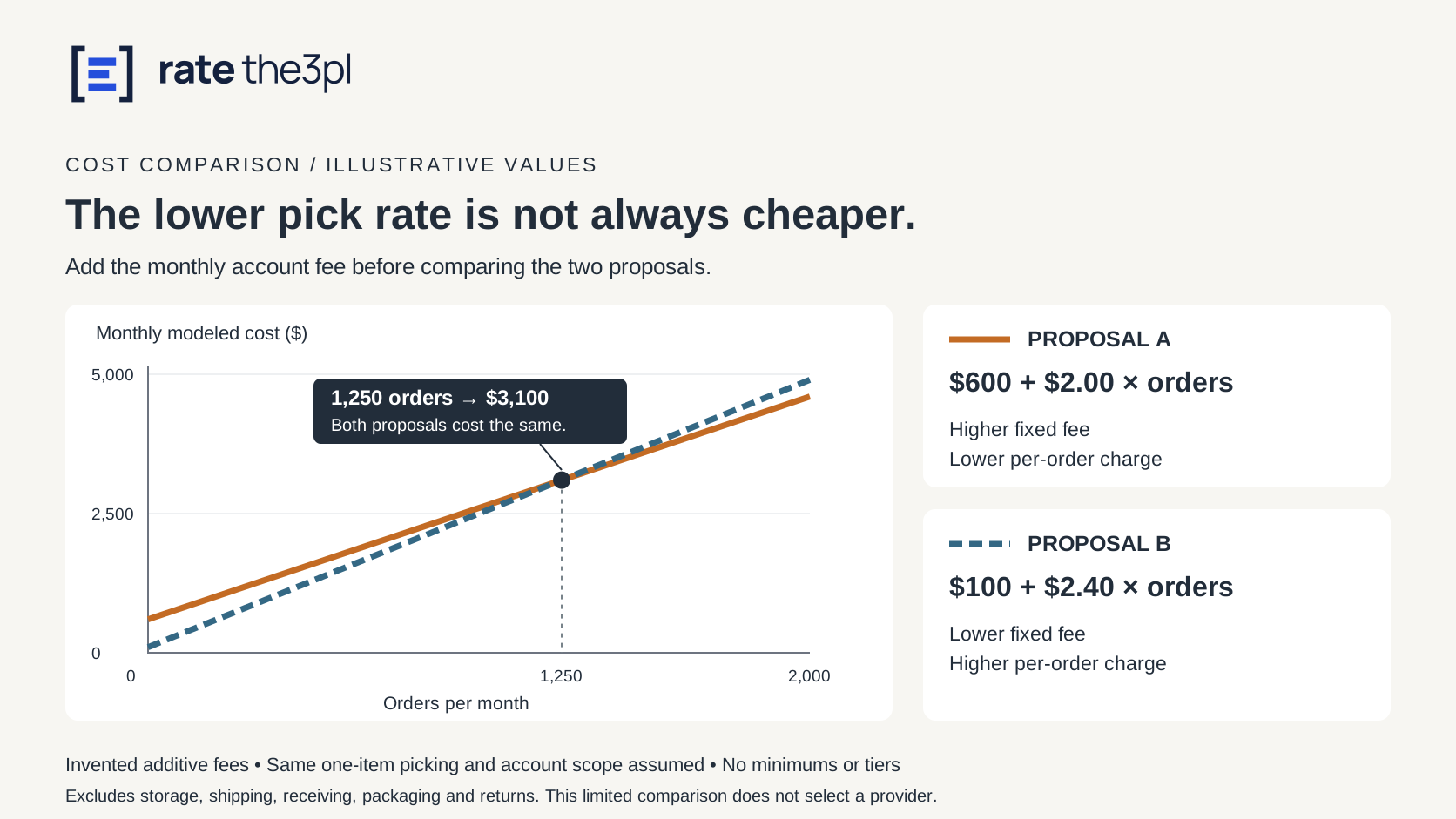
Assume Proposal A charges $600 per month plus $2.00 per order. Proposal B charges $100 per month plus $2.40 per order. For this example, the per-order fee covers exactly the same one-item picking work and the account services are assumed equivalent. No minimum, tiers, tax or setup fee applies in the model.
| Orders in the month | A: $600 + $2.00 × orders | B: $100 + $2.40 × orders |
|---|---|---|
| 500 | $1,600 | $1,300 |
| 1,250 | $3,100 | $3,100 |
| 2,000 | $4,600 | $4,900 |
A adds $500 in fixed fees and saves $0.40 per order. The modeled crossover is $500 ÷ $0.40 = 1,250 orders. At 500 orders, A costs $300 more. At 2,000, it costs $300 less. Choosing solely on the $2.00 pick rate would miss the low-volume outcome.
Check the year without concealing the quiet months
Suppose an invented year has eight 500-order months and four 2,000-order months: 12,000 orders in total. A costs $7,200 in account fees plus $24,000 in usage, or $31,200. B costs $1,200 plus $28,800, or $30,000. B is $1,200 lower for that year under these linear terms.
Using the average of 1,000 orders per month gives the same annual answer here because both formulas are linear and the fixed fees apply all year. It will not necessarily do so when the contract contains monthly tiers, minimums, temporary waivers or step changes. Build the month-by-month version whenever those terms exist.
The annual calculation does not remove a cash-planning concern in a quiet month. Ask whether a pause in shipping changes the account charge and what notice or conditions apply. Do not assume that a zero-order month means a zero invoice.
The cheaper bundle still needs a scope check
Request a written list of included reports, users, integrations, meeting cadence and support responsibilities. Mark each item as included, extra or unknown. A fee with a similar name can buy a different service; a comparison that assumes equivalence should say so until the scope is verified.
If one quote includes a task your team would otherwise perform, estimate that work separately using your own assumptions. Do not assign a convenient value just to favor the lower pick rate. Equally, do not count an included software or service charge twice elsewhere in the spreadsheet.
Put the crossover beside the quote
Add storage, packaging, receiving, shipping, returns and other agreed charges to compare the complete arrangement. Our numbers exclude those categories and therefore cannot select a provider by themselves. Multi-item orders may also need a different usage model from the single-item assumption used here.
Ask each candidate to price your quiet month and your expected busy month with every recurring fee shown. Then label the volume at which the alternatives cross and the contract assumptions supporting it. That gives the buyer a usable answer to “cheaper at what volume?” instead of a headline pick fee.
Further reading
Sources
- https://www.sba.gov/counseling/plan-your-business/ — accessed 2026-10-31.